Security firm Claroc has found that tens of thousands of apps built with Grok Build, the app-making mode of SpaceXSI's Grok, could be opened by anyone who had the link, with no sign-in. After listing app addresses under the grok.me domain on 8 November 2026, it counted 43,601 names. Of the 37,571 still online, 35,578 (94.7%) opened without a login, and only 1,993 (5.3%) answered with an HTTP 401 refusal. A search summary gave a slightly different count of addresses tested, 43,551, which could not be verified, so the figures here are those published by Claroc and relayed by MLQ.
Among the open apps were 24 built by staff at SpaceXSI, the merged SpaceX and xAI, and at X. They included a confidential sales onboarding plan with 19 internal chat channels, a territory map of 594 strategic accounts, eight X advertising proposals and four live advertiser boards. One proposal, addressed to a U.S. federal agency, was marked confidential. Only one app, an archive of ad measurement studies, asked for a password. The researchers said they were shocked that the company behind Grok had its own internal material open to anyone with the link, and that nobody had given them that link in the first place; Engadget attributes the reaction to the researchers generally, while MLQ names Claroc co-founder and CTO Asaf Aprozper.
“AI app builders turned publishing into a few clicks, and the default answer to who can see it is everyone,”
Asaf Aprozper, Claroc Research, in Claroc's report · blog.claroc.io ↗
The exposure was wider than the company's own material. Claroc says roughly one in ten open apps held sensitive business or personal data, about 2% were high or critical, and it estimates 650 to 800 held private information. Examples included a hospital group's roster of more than 3,500 employees, an ICU patient briefing, a fire department's shift board with badge numbers and a timesheet with 18 plain-text passwords. Thirty other organisations had internal data open, 26 with more than 1,000 staff and six in the Fortune 500, though Claroc names none. Ars Technica, as relayed by MLQ, found a Tesla service-centre scorecard naming 22 technicians and medical exam records for 3,784 workers at a Peruvian construction firm.
The cause is how the links are built. Each app lives at its own address, a name of about four random words followed by grok.me, so the secret sits to the left of the domain, where passive DNS databases record it. Engadget cites up to 38 bits of entropy for such names. Claude artifacts, ChatGPT shares and Gemini shares put the secret in the URL path, which DNS never sees, while Lovable, Replit and others also give each app its own hostname. In Claroc's paid test account the publish panel offered "Anyone with the link", "Invited users" and "Only you", with the first already selected. The difference matters because a secret held in the path stays out of passive DNS records, while one held in the hostname does not. Its two test apps showed the consequences: a contact list without a login let a stranger add a row, and a four-person team app let an uninvited Google account read, edit and delete records.
Claroc reported the onboarding plan and an X ad proposal to SpaceXSI on 8 November and details of the other 22 staff apps the next day. According to Engadget, nothing came back until Claroc tagged Elon Musk and another company official on X, after which the 24 apps were taken down. Ars reported that they were still open on Monday evening and returned "app not found" within hours of its questions. Claroc published its findings on 10 November without hostnames, so that no one could use the report to find the open apps. Claroc argues that the problem lies in a default that many app builders share, not in a bug in any one app, and it treats SpaceXSI's own exposure as an illustration of how easily the setting is missed, even by the people who built the product.
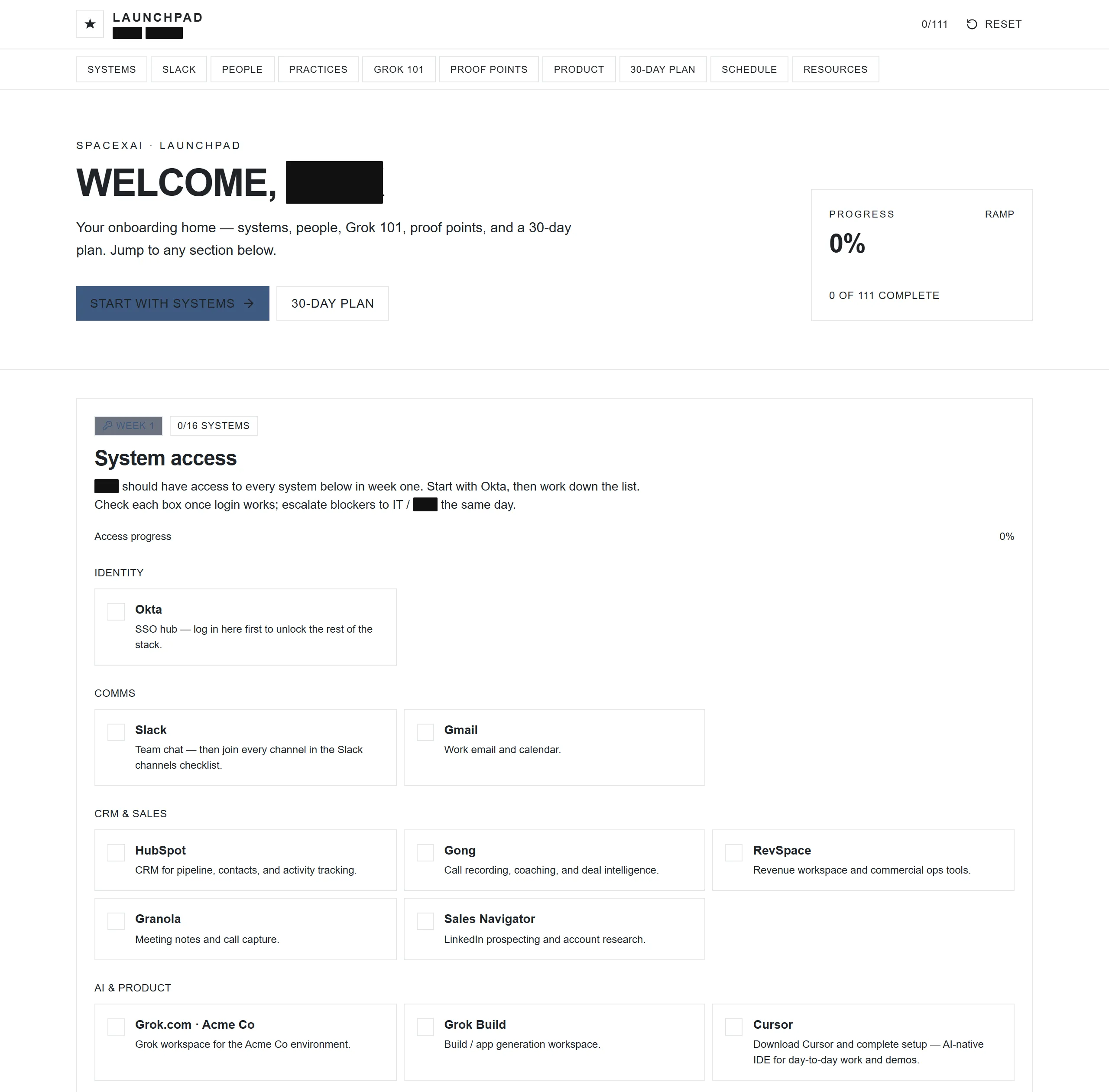
SpaceXSI's internal sales onboarding plan as it appeared in an open Grok app, names covered by black bars
Claroc Research · Image: Claroc Research
SpaceXSI's position, as relayed to a reporter, is that Grok apps stay private until their creator shares them, that publishing takes several steps and a legal disclaimer, and that employee accounts default to Only you. Claroc answers that extra clicks mean little when the preselected audience is everyone, and that the employee default did not keep SpaceXSI's own data private. A Cursor representative told Ars that apps there are private by default too, and did not reply to follow-ups. Cursor is a recently acquired subsidiary of SpaceXSI.
Claroc asked for apps to be served under a path on one host, an organisation-only sharing option, Only you as the default and a warning for apps that have a database but no sign-in. It says SpaceXSI described the default as a design choice, not a bug it planned to fix, and that the company had not said it would contact the owners of the other open apps. Claroc is notifying affected organisations itself and had emailed three by publication. The firm, not SpaceXSI, is therefore the one reaching out to the people whose files were exposed. The report follows its earlier look at Meta's Muse apps, and a July 2026 finding that Grok Build's command-line tool uploaded whole repositories, Git history and secrets included, to cloud storage, after which Musk promised the data would be deleted.
About Grok Build
Grok Build is a terminal-based AI coding agent and command-line tool from SpaceXSI, sold to SuperGrok subscribers at $30 a month. It can run up to eight agents at once through plan, search and build stages. As of 15 May 2026 it scored 70.8% on SWE-bench Verified, and SpaceXSI's Grok 4.5 model launched on 8 July 2026, first through Grok Build, the Cursor editor and the API console.
This is not the first time it has raised a data question. On 14 July 2026 researcher Tinh Dang reported that the Grok Build command-line tool uploaded whole repositories, with Git history and committed secrets, to a SpaceXAI cloud storage bucket. The company stopped the uploads with a server-side flag, Musk promised that all previously uploaded data would be deleted, and Grok Build was open-sourced under the Apache licence on 16 July 2026.
Claroc also points to an earlier episode of the same kind. In August 2025 more than 370,000 shared Grok chats surfaced in Google search results. Taken together with the July upload finding and the new report, it describes a pattern in which sharing and publishing defaults, rather than deliberate releases, put private material in public view.
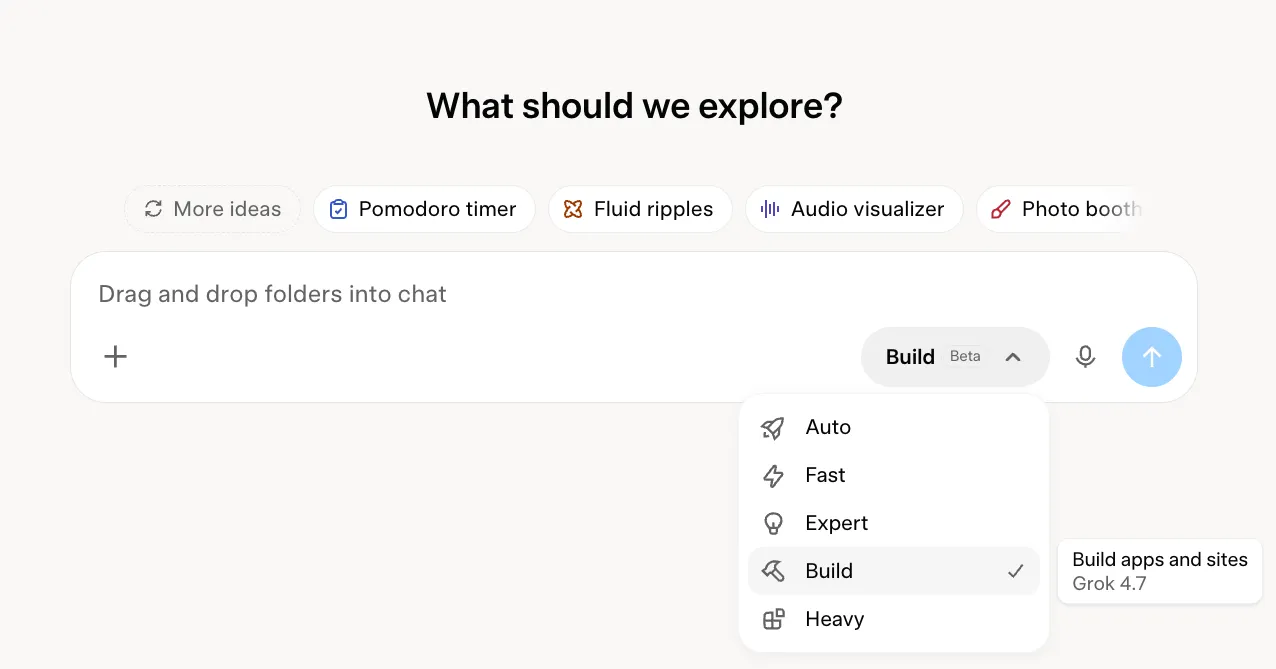
Grok's start page with the mode menu open and Build (beta) selected, the mode where users describe an app and Grok writes it
Claroc Research · Image: Claroc Research
Sources · 3
Comments