
Mike Hichwa, Oracle's senior vice president of software engineering, told theCUBE at Oracle AI World that most code is now written by machines, and that Oracle built a new language to keep that output under control. SiliconANGLE published the interview on 4 November 2026 and discloses that it and theCUBE were a paid media partner for the event, with no editorial control held by Oracle.
The language is APEXlang, which Oracle introduced in August 2026 alongside the APEX AI Application Generator in Oracle APEX 26.1, running on Autonomous AI Database Serverless in Oracle Cloud Infrastructure. It is a heavily abstracted way of describing an application: it records what the app should do rather than how it is built. A definition covers pages, navigation, forms, reports, dashboards and business logic in a declarative form that people can read. Oracle compares the approach to SQL, where you state the result and the engine decides how to get there.
The thinking, as Hichwa explains it, is that companies will generate applications hundreds or thousands of times and will then want consistency, governance and ease of understanding. A small definition is easier to follow than a mass of generated code, he says, which cuts down on sloppy output; he likens it to a set of study notes rather than the full book. Oracle's own announcement framed the answer as rethinking what AI generates rather than producing more code.
“What we’re generating is much, much smaller, much more human understandable, so it is less sloppy because it is more abstracted. It’s like a CliffsNotes. It’s not the full book.”
Mike Hichwa, senior vice president of software engineering, Oracle, to theCUBE · siliconangle.com ↗
Oracle is releasing the APEXlang grammar, skills and documentation into the public domain so that outside coding agents can write it. Claude and Codex are named as targets, and theCUBE Research adds Cursor. Oracle is working with OpenAI to train models to produce the language more efficiently. The APEX engine interprets what the agents generate, and Oracle patches and updates that engine monthly. According to theCUBE Research, the agent writes a definition, the APEX compiler checks it, and if there is an error the agent corrects it and tries again. Definitions can be compared, versioned and released through existing source control, testing and rollback, and because APEX runs inside Oracle Database, apps inherit its access controls, data masking and virtual private database policies.
The tooling is meant to fit several ways of working. Developers can use the low-code App Builder, Oracle's native AI agents, outside agents, VS Code or Oracle's SQL developer tools. The examples theCUBE Research gives are everyday requests: add a chart, convert a pie chart to stacked bars, or translate a whole app into Spanish. The agent edits the compact definition instead of rewriting thousands of lines.
The analysts at theCUBE Research see Oracle offering the model makers a well-documented target rather than competing with them, a credible stance for companies already using Oracle. They also warn that APEXlang does not answer risks such as prompt injection and does not yet turn business intent into explainable logic, which Oracle accepts is unfinished. Oracle says reference apps, interface patterns, examples and updated guidance for agents are on the way.
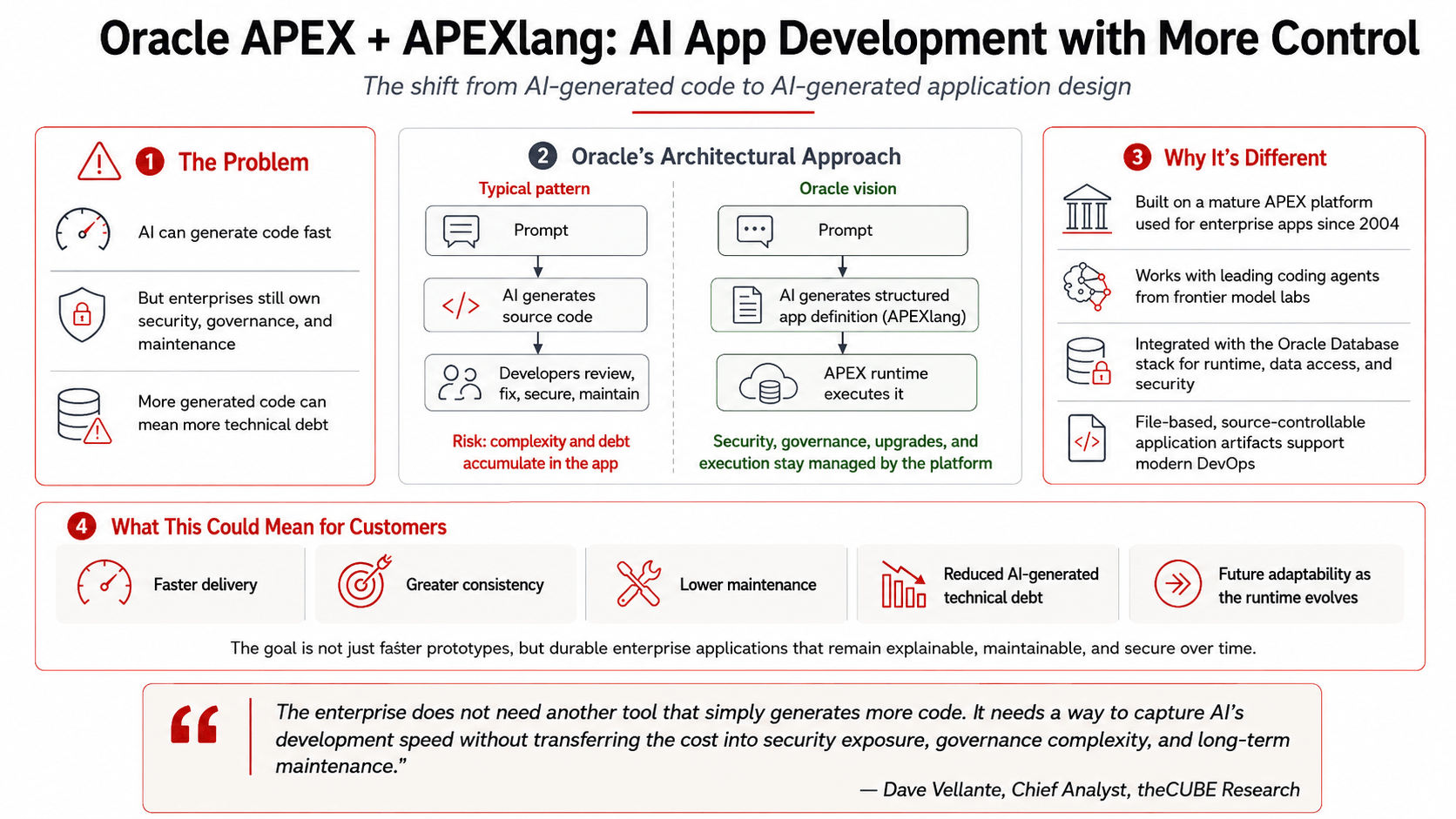
Graphic for theCUBE Research's August analysis of Oracle APEX and APEXlang
Image: theCUBE Research
Oracle frames the whole approach as keeping the benefit of speed while restoring control. Changes made through APEXlang can be inspected before release, and the engine that runs them is patched and updated by Oracle every month. Trade outlets covered the original APEXlang and generator launch on 12 and 13 August 2026, so the November interview is a follow-up to a product already on sale.
Hichwa put the shift in simple terms: in 2025 most code was still written by people, and from 2026 onward most of it will be generated by machines. His case for APEXlang is that this makes a shared, readable layer more important, not less, because the same application may be regenerated again and again and still has to behave consistently.
About Oracle APEX
Oracle APEX, short for Application Express, is Oracle's low-code platform for building web, mobile and desktop apps, with a browser-based environment of wizards and drag-and-drop builders. It is a feature of Oracle Database.
It was created by Oracle developer Michael Hichwa, building on his earlier WebDB. The platform dates to 2000 under the working name Flows and has also been called Project Marvel and HTML DB. APEX was first offered in 2004, and Oracle says customers have built more than 20 million apps with it, with APEX included at no extra charge with Oracle Database. In August 2026 Oracle launched the APEX AI Application Generator with APEX 26.1 and introduced APEXlang, a definition language for AI agents.
APEX has been Oracle's low-code platform since 2004, and Oracle claims more than 20 million apps have been built on it, at no extra charge with Oracle Database. Coding agents have blunted the speed advantage that low-code once offered, which is the gap APEXlang is meant to address.