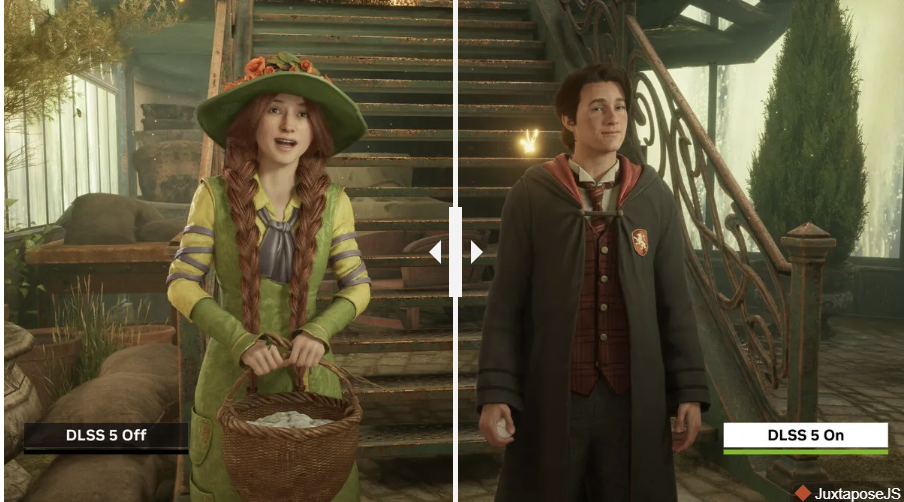
Nvidia's DLSS 5, which it markets as DLSS 3D-Guided Neural Rendering, went live in Hogwarts Legacy on 5 November, with a launch trailer. The in-game effect looks far subtler than the earlier tests. Nvidia says the aim is to lift lighting and material quality while preserving character identity. Some viewers now say it is so subtle they can barely notice it, and they are wary of the extra power draw for so little visible change.
Support is limited to GeForce RTX 50 Series cards and RTX Spark systems. With 6X Multi Frame Generation, Ray Reconstruction, Reflex and ray tracing switched on, the game can reach 4K at up to 300 frames per second on an RTX 5090. Creative Bloq's writer finds that some scenes gain contrast, though the extra environmental detail can make others feel less atmospheric. DLSS 5 comes next to War Thunder in mid-November and to Where Winds Meet on 23 November.
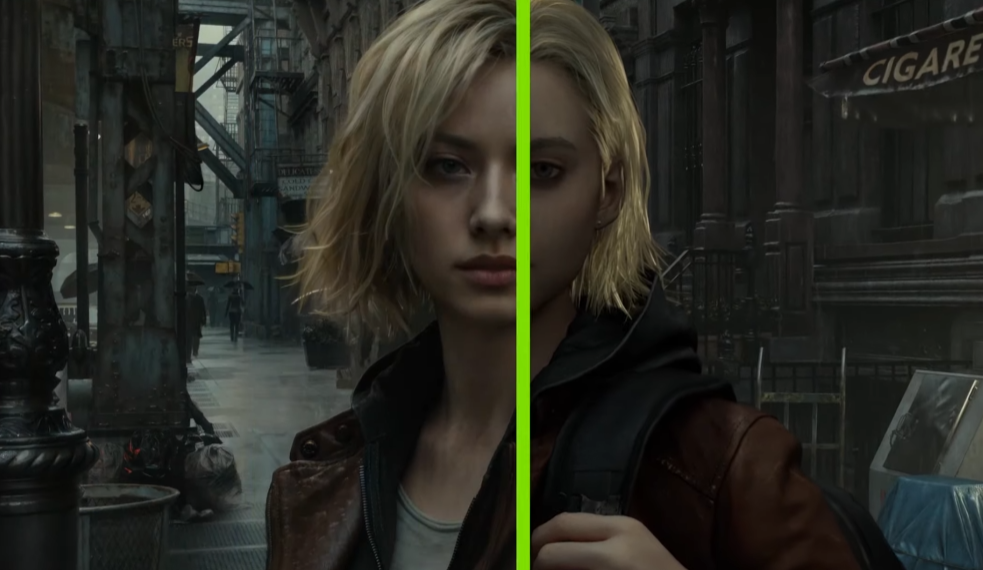
Lead image from PC Gamer's reveal-day piece on DLSS 5 altering game characters' faces
Image: PC Gamer
Nvidia revealed DLSS 5 in March as a generative-AI model that adds photoreal lighting, texture and material detail in real time. The demo gave Grace in Resident Evil Requiem fuller lips and sharper cheekbones, and the phrase "AI slop filter" appeared within minutes. In August an unfinished build leaked through a library file in NBA 2K27, and modders shared clips complaining of uncanny, AI-looking or older faces. Commenters under the new trailer say the first presentation was over the top and the release has been toned down.
About DLSS 5
DLSS 5 is Nvidia's real-time generative-AI neural-rendering model, which enhances lighting and material surfaces at up to 4K while, Nvidia says, keeping a developer's art style. It belongs to the DLSS family, first sold in 2018 as a feature of GeForce RTX 20 series cards.
Nvidia chief executive Jensen Huang presented DLSS 5 at the company's GTC conference on 16 March 2026, with a release planned for fall 2026. Unlike the earlier DLSS versions, which upscaled and smoothed images, it uses a generative model to add detail to the picture while the game's 3D renderer supplies the structure it follows.
Sep 2026
Released
Nvidia has said, through Jacob Freeman and chief executive Jensen Huang, that developers keep artistic control and that the generative AI is steered by the structured data of the 3D renderer. Bethesda said the technology in Starfield would be under its artists' control. Critics argue that it imposes a beauty standard and risks letting technology firms, not creators, decide how games look. Hogwarts Legacy was one of the launch games named at the reveal.
Sources · 2