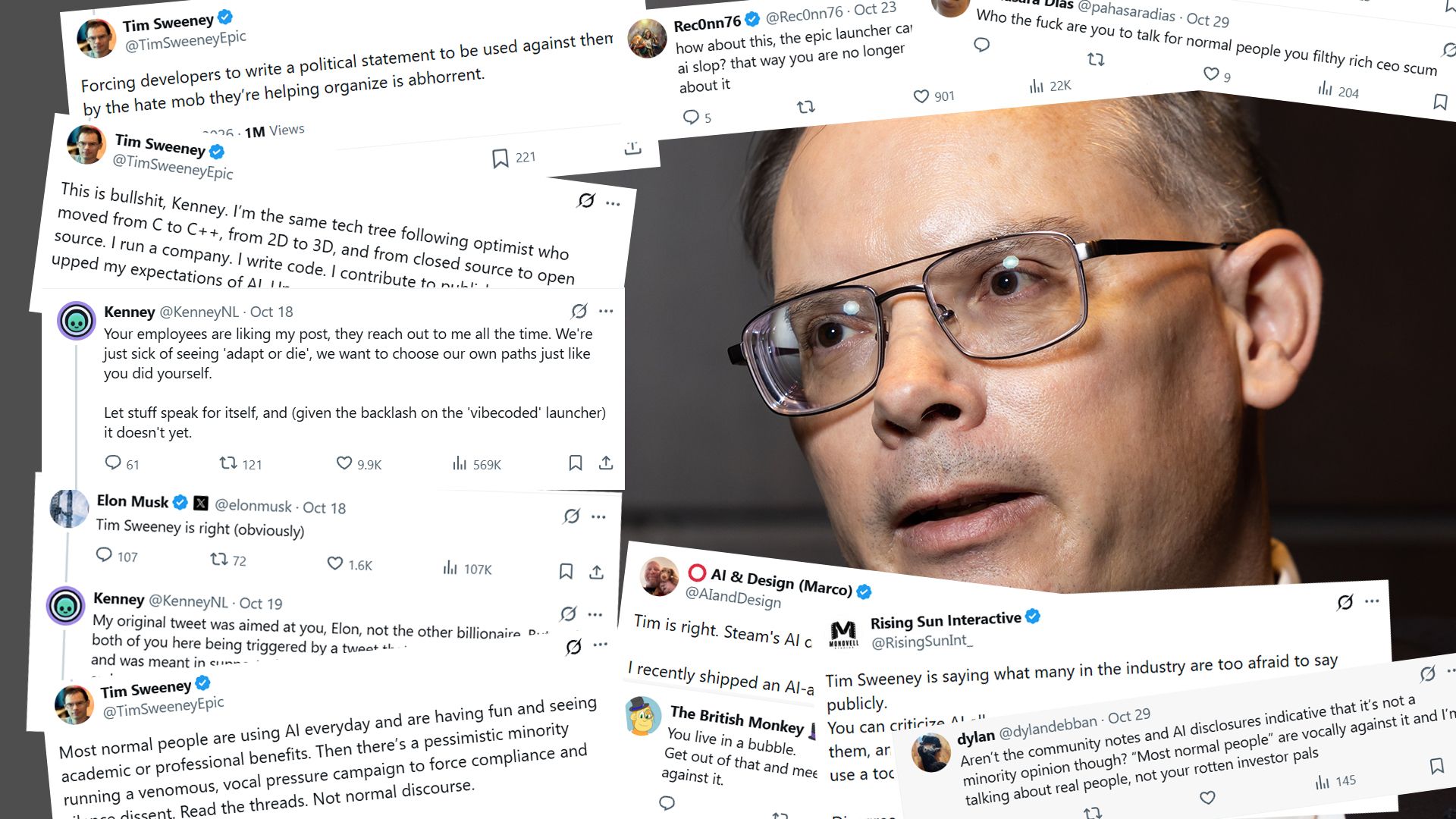
A public argument between Epic Games chief Tim Sweeney and Kenney, an artist known for giving away game assets, has become a reference point for how split the games world is over generative AI. It began on 18 October, when Kenney told fellow artists not to let billionaires persuade them that AI "slop" is the future. He has said he was answering something Elon Musk had written, not aiming at Sweeney. Sweeney answered within hours, calling the post bullshit and signing off with "Up yours!". Musk then weighed in on Sweeney's side. PC Gamer revisited the row on 6 November, after hundreds of replies and a first consequence: the developer Dead Teapot pulled its Epic Games Store release in support of Kenney.
“If it were true and AI has had mass adoption, why even bother going after me or trying to convince me to start using it?”
Kenney, game asset artist, on X, quoted by PC Gamer · pcgamer.com ↗
Sweeney's case is that AI is what makes development affordable and that opposition comes from a loud minority, some of it, he suggests, "astroturfed". PC Gamer says it has seen nothing backing that claim. He compared the shift to earlier ones in the industry, such as moving from C to C++, from 2D to 3D, and from closed to open source. Pressed on his own standing, he pointed out that he runs a company, writes code himself and has contributed to published papers, so this is not an outsider's view. He also argued that studios holding out risk being left behind, and framed it as a race between cars and rockets. He expects studios to gain two to four times the productivity, and he says Epic should be making the positive case for AI more loudly.
Kenney's view is more mixed. He grants AI some benefit but calls it immoral as it stands, citing data centres, the use of stolen training material and harm to the industry. He asks why anyone would bother to convince him if AI adoption were already a fact, and says that if staying away means being left behind, "Please, leave me behind". He adds that Epic staff like his posts and contact him privately, and says he is tired of the "adapt or die" message that comes with the pitch. In his telling the pressure runs one way: a small group, billionaires among them, is trying to make AI feel normal, and the people who object are the ones asked to justify themselves. His own work is the opposite of the AI pitch: he gives away thousands of assets, and a $20 bundle with all 60,000 of them, plus donations, pays his living.
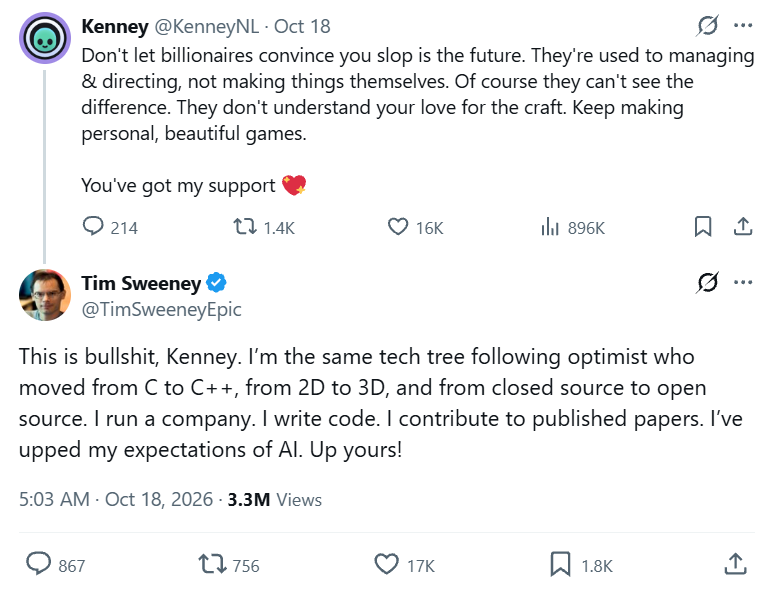
Screenshot of the X posts between Kenney and Tim Sweeney
Kenney/Tim Sweeney · Image: PC Gamer
The argument lands as Epic leans into AI. It says its next Unreal Engine release goes all in, describes its new launcher as vibe coded, and has announced an AI game jam, all of which has drawn criticism. GamesRadar describes the company as having recently pivoted to AI-led development, and the backlash to that pivot is the backdrop to Kenney's post. Sweeney also reposted an AI-made cartoon of an anti-AI mob wrecking a developer's launch, with the line "This is exactly what's happening", and has called Steam's AI disclosure requirement abhorrent.
About Tim Sweeney
Tim Sweeney, born in 1970, is an American game programmer and businessman, the founder and CEO of Epic Games and the creator of the Unreal Engine. Epic launched the Epic Games Store in 2018, and under him the company behind Fortnite grew into a platform business.
This is not the first time Sweeney has argued in public about AI and storefronts. In late November 2025 he said on X that stores such as Steam should not carry AI labels, since AI would be everywhere. He has also been in earlier fights with platform owners: in 2020 he led Epic's challenge to Apple's App Store after it pulled Fortnite, and a judge largely sided with Apple in September 2021. In March 2026 Epic announced layoffs of more than 1,000 staff and settled with Google over Play Store fees.
PC Gamer sets the row against some numbers. Arc Raiders used generative AI, scored 2 out of 5 at Eurogamer and still sold over 16 million copies. A GameDiscoverCo survey found about 69% of Steam users neutral or fine about games that disclose AI use, while over 55% want stricter disclosure rules. The figures pull in different directions: tolerance for disclosed AI is common, but so is appetite for stricter disclosure. A GDC survey found over half of developers think AI is bad for the industry. Moon Sweepers, which discloses its AI use, announced 600,000 sales. Larian also drew pushback last year for discussing limited AI use on Baldur's Gate 3. The coverage names no next step in the dispute itself. Kenney says people are welcome to leave him behind and that he is happy where he is, still making assets anyone can download.

A sample of the free game assets Kenney publishes on his website
Kenney · Image: PC Gamer

Still from an Epic Games video used to illustrate Epic's AI push
Epic Games via YouTube · Image: GamesRadar
Sources · 2