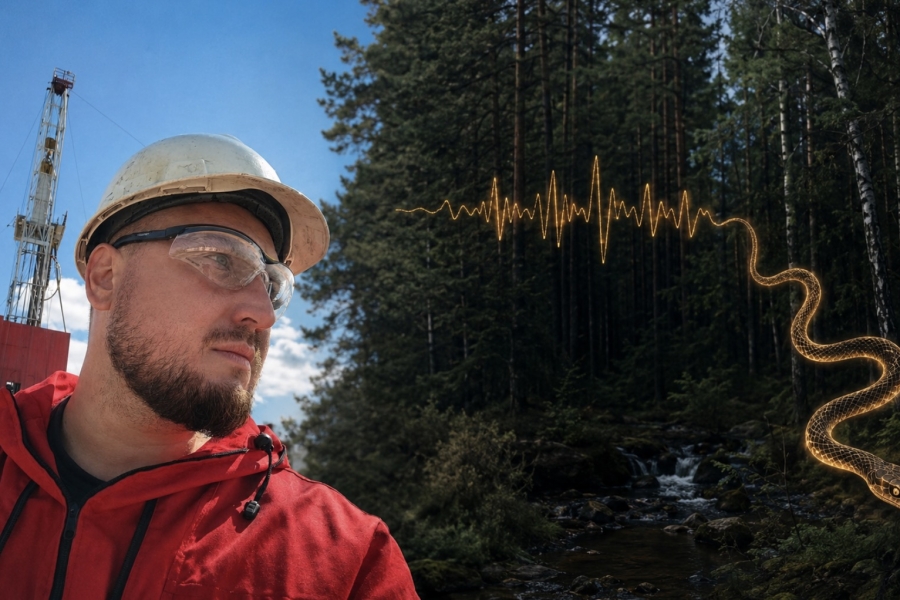
A 41-year-old Belarusian who works rotating shifts in the oil and gas industry has built a small, loyal audience for AI-generated dance music in the Belarusian language, Nasha Niva reports. Dzmitry Yarmolich lives in Minsk and has worked on rigs on Alaska's North Slope and now in Russia's Yamal region. He releases the songs as Vuž, Belarusian for grass snake, and writes about his experiments on social media. He is married with children, and makes the music between stints on the drilling rigs.
Music is not new to him. As D-i-medroL he put out lyrical tracks, and in 2017 a parody video of rig workers dancing to a reworked hit by the band Griby, recast as a song about shift work and drilling, spread widely online. Vuž, which started in December 2025, is something else. It draws on Belarusian language, mythology and history, set to club beats and ethno-house.
He launched it with a trick. His early TikTok posts presented the tracks as though he had stumbled on exciting new Belarusian music. Viewers were delighted to hear their language in modern dance music, and one clip got about 200,000 views in a day. Hundreds of comments came in, most of them warm, though some commenters guessed it was AI. Only then did Yarmolich admit the project was his: he writes the lyrics and prompts, and a neural network makes the music and vocals. He said he had always wanted to make something good in Belarusian that people could play in the car to lift their mood.
The songs have limits. Music generators handle English and Russian far better than Belarusian, so stresses and pronunciation are sometimes off, and fluent listeners notice. Yarmolich mostly takes criticism calmly, though he sometimes answers the harshest critics. He describes the project as Belarusian code in digital sound. The project has grown anyway. It now includes female vocals, Belarusian versions of known songs such as Aliaksandr Saladukha's Green Grapes, and songs with AI videos about folk spirits like the Bahnik. There is also a series about women from Belarusian history, among them Rahnieda and Euphrosyne of Polotsk, each with a short historical note.
AI lets him work at a pace no band could match. In about six months he has released five albums, including Lios, with 17 tracks running over an hour, and the August album Zero Kilometer. They are on Spotify, Apple Music and Russian services. His TikTok, which he built up specifically for the project, has about 5,400 followers. Fans send him personal stories that he turns into Belarusian-language songs, and he asks them which sound variations they prefer. The result is a small but engaged community: around 150 fan videos were made for one track, the wedding song Viasellie. For his second album he said he wanted to weave the rhythm of modern life together with Belarusian mythology, and with love, both happy and heartbreaking.
His audience is older than you might expect. In a poll on his Telegram channel, almost half of respondents were over 45 and 38 per cent were aged 35 to 44. Only four were under 25.
The main argument about Vuž is whether he counts as a musician. Critics say he just turns the handle on a machine. He replies that every new generation of creators has faced snobbery, and that a neural network is an instrument like a guitar or even wooden spoons. In his view, good prompting takes taste and precision, and without a person supplying meaning, AI only churns out junk. He also argues that AI has opened music to people who could never pay for a studio, mixing and mastering. A track once cost hundreds of dollars across beat, studio, mixing, mastering and distribution, he says, while a free tool or a subscription of 10 to 15 dollars now does the job. In his words, a closed club has become a contest of ideas rather than wallets.
Nasha Niva disputes some of this. It says a generator can deliver a polished result fast but not reliable diction, correct stress, an original arrangement or control over individual parts. It adds that a generator's user steers far less than a producer working with samples or autotune. The paper also notes that cheap production does not guarantee success. The advantage shifts to whoever masters the algorithms, spends on promotion or releases constantly, so AI swaps the industry's old gatekeepers for platform ones. Even so, it accepts his core point: for the first time, someone with no musical training or money can hear an idea as an almost finished song.
Yarmolich cites other Russian-language AI acts as proof of what is possible. SDP sets classic poems, including Yesenin's, to modern music and has millions of plays on Spotify and YouTube. Sasha Komovich went viral with an AI version of a New Year song from a Soviet cartoon. AltVerse is widely credited online with a viral Afro-soul cover of Stromae's Papaoutai. The paper points out that each one reworked material listeners already knew and broke through with a single track.
Vuž has had no hit that big. What it has, the report suggests, is a clear theme and a real author who is open about himself, rather than a made-up persona: a rig worker who, between trips to the far north, writes about medieval princesses, swamp spirits and unhappy love. In one video Yarmolich asks whether people would still be creators if their instrument, or their AI, were taken away. His answer is that creativity lives in the mind.
Sources · 1