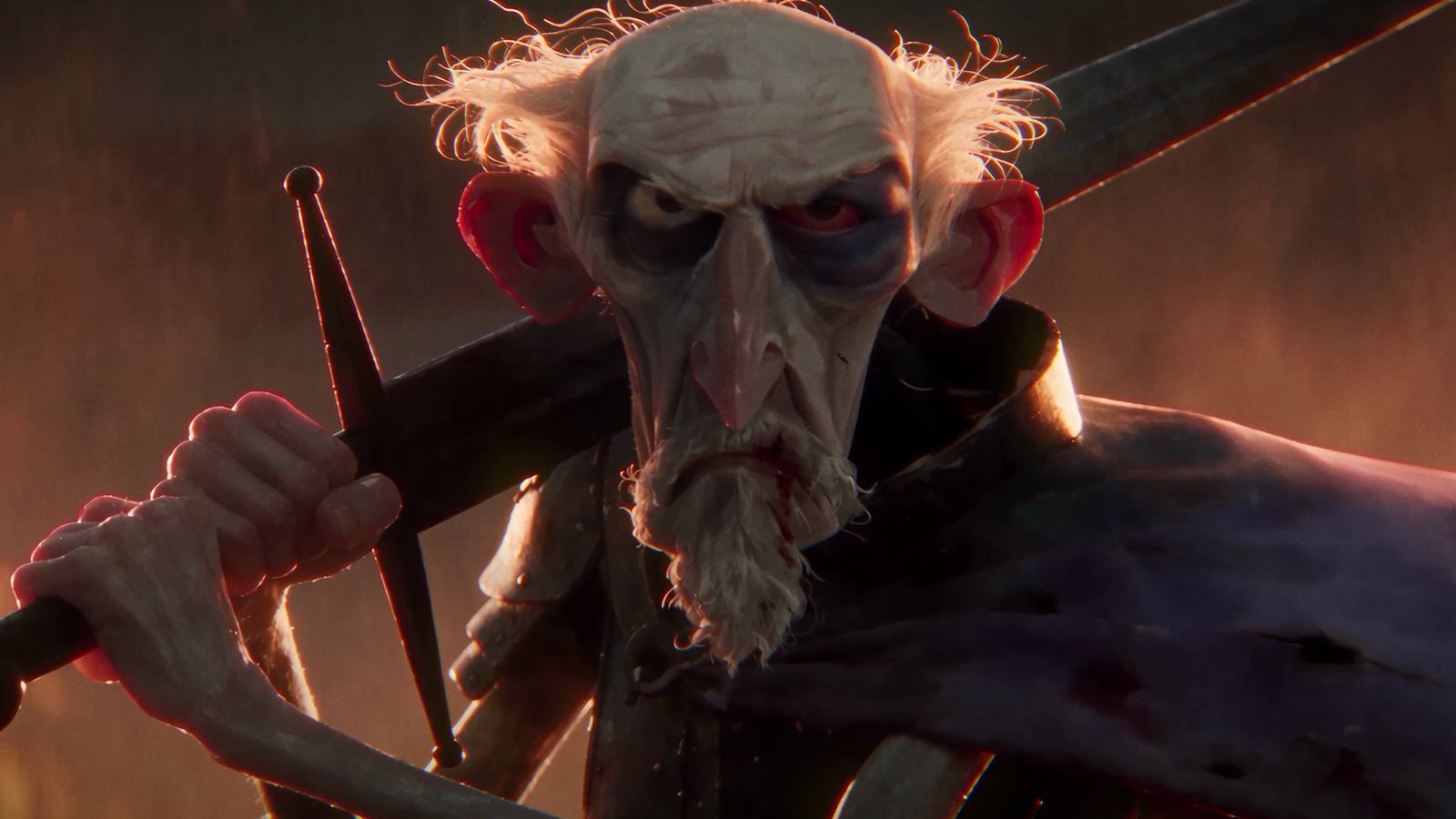
Guillermo Miranda and Javier de la Chica, two animators who now treat generative AI as their main medium, premiered La Triste Figura (The Sorrowful Figure) at a small art cinema in Madrid on 23 September. The 11-minute comedy-adventure retells the windmill episode from Cervantes' novel, a book with a long history of adaptations that stalled or collapsed. It was co-produced by Magnific and made on that platform, and Creative Bloq's Ian Dean attended the screening and interviewed both directors.
Dean's account of the room is that the jokes and the dialogue landed with the audience more than the action and visual polish, which AI shorts usually manage well. De la Chica, a long-time admirer of the novel, says the tools finally let them attempt an adaptation he had been turning over for years. Miranda adds that their earlier shorts leaned on local Spanish culture, and that picking a story everyone already knows let them bring their own tone without setting up the context.
Both come from conventional animation, where work is divided into departments. Here a small group moved across every stage instead: the official notes list ten people, while Miranda puts it at about a dozen, rising to around 30 at the busiest point. The two directors worked from different cities inside one shared project and watched each other's generations as they came in. De la Chica, who started experimenting with early tools around 2019, says the aim is to make AI production feel like a multiplayer game rather than software for one person working alone.
It is also their first film with a storyboard artist and a composer on the crew. Víctor Ponce drew the boards by hand and is credited as assistant director, screenwriter Álex Rey helped sharpen the jokes, and Arturo Liberos and Juan Rabadán voice Quixote and Sancho. Early synthetic voices were dropped because they tripped over the archaic language. For the key shot of Quixote pushing himself up on his sword, de la Chica acted the movement out on the floor as reference, as an animator would.
The pipeline started with a full production design: turnarounds, expression sheets, costume tests, combat poses for the giants and a group image fixing the proportions of the knight, his squire and their mounts. Shots were then generated as video from those references and mostly Spanish-language prompts, chiefly in Seedance 2.5, with characters and assets built in Seedream 5 Pro. The press notes count about 1,200 generations for roughly 120 shots in the final cut. Because Quixote's design is asymmetrical, a good shot could not simply be mirrored, and a doubled sword or a cape on the wrong side meant generating it again.
The directors are candid about the limits. Miranda calls the film a prototype rather than a technical showcase, says the output is still not the same thing as animation, and argues it is close to ready for entertainment but makes no sense yet in his other field, medical animation, where accuracy is essential. De la Chica says the process costs less than traditional animation but still needs money and a team, so it is not yet a democratisation of the medium; what it offers is room to take risks in an industry that mostly funds established properties.
The hardest scene was not an effects shot but a roughly five-minute comic conversation between four characters with windmills turning behind them, nearly half the running time. Keeping everyone consistent was difficult, and the windmills would not rotate at a steady speed without warping, so the team let physical realism go in favour of comedy. Small fixes proved harder than big ones: Miranda notes that a subtle tweak costs about as much as a complex shot, so replacing a whole sequence can be the easier route, and solving one problem added about a minute and a half to the film.
They acknowledge unease around the work. Some industry friends disapprove, others are curious but reluctant to say so, and de la Chica expects large studios to employ fewer artists even if more small studios appear. Both say they want a voice in how any new industry is shaped and bring in industry people where they can, and they have no interest in a pure AI film for its own sake. The short can be watched on Magnific.
Sources · 1