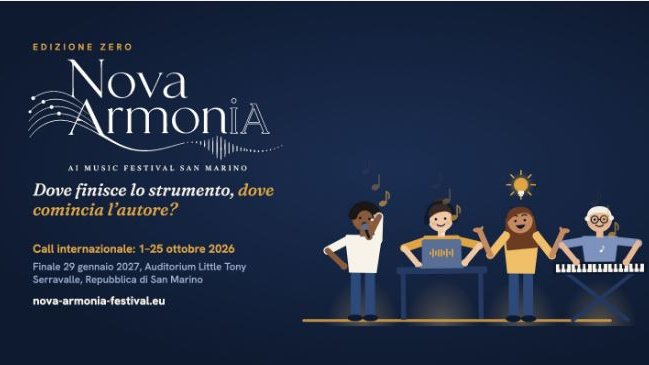
San Marino is getting its first festival for music made with generative AI. Nova Armonia, billed as the AI Music Festival San Marino, opened an international call for songs on 1 October, according to an announcement from the organisers published by San Marino RTV. Submissions are taken through the festival's website until 25 October, and the final of this pilot edition, called Edizione Zero, is set for 29 January 2027 at the Auditorium Little Tony in Serravalle.
The organisers, the Vo.Ci. Nei Castelli association working with the Serravalle castle council, say they will reward authorship rather than the generated output. Every entry must come with a process sheet that sets out the original idea, the tools used, the human role and the choices and discards along the way. A song made from a single prompt is as eligible as one built over dozens of attempts, provided the account of it is honest. The association describes the argument over AI music as split between uncritical enthusiasm and flat rejection, and says it wants a more serious and curious space to play and discuss these songs in public.
Everyone involved, from entrants and jurors to partners and organisers, is bound by a charter of five principles: transparency, human centrality, respect for artists, experimentation and public education. Songs that deceptively imitate living artists, use recognisable voices without permission or draw on protected works without the rights holders' consent are not allowed. The charter presents itself as neither for nor against AI.
Anyone aged 18 or over, of any nationality, can submit up to three songs in any language, or instrumentals, including tracks already released, as long as they are not registered with SIAE or another collecting society. Each entry costs 10 euros, refunded to finalists, and authors keep their rights. After a technical check, a jury drawn from music, research, journalism and education will choose between 8 and 12 finalists, to be announced on 16 November.
At the final, each song will be presented with the story of how it was made and a staging of the author's choice, which can be a projected video, choreography, or a live or simulated performance. Five prizes will be handed out, among them awards for the best human-machine dialogue and for creative transparency, plus an audience prize. An introductory talk, a workshop for students and a masterclass for musicians on using generative tools are also planned, and the organisers call them an essential part of the project.
Sources · 1