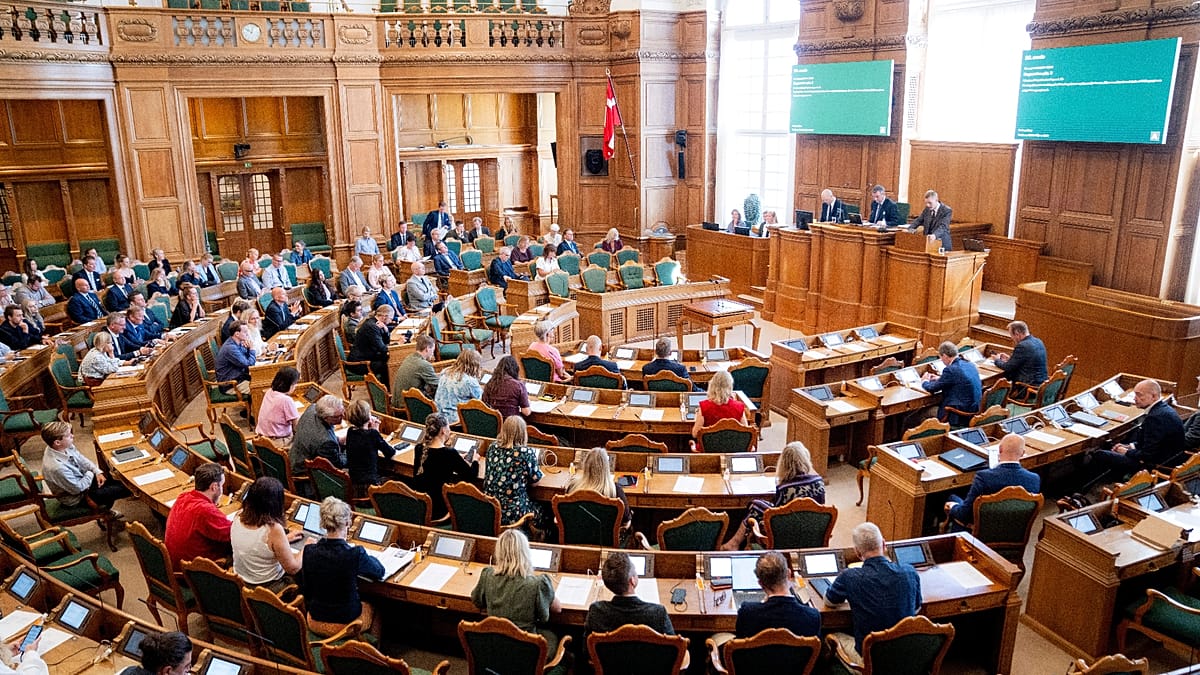
Denmark's culture minister, Zenia Stampe, put a bill before the Folketing on 8 October 2026 that would make it unlawful to publish a realistic digital imitation of someone's face, voice or movements without that person's agreement. Filed as L 49 and running to 36 pages, it amends the Copyright Act and is meant to take effect on 1 January 2027, if parliament passes it. A Danish media lawyer who covered it on LinkedIn says this is a second go: an earlier version fell when the country held a general election, and the new text is a revised one.
The policy itself dates back to a political agreement of 26 June 2025, struck by the then coalition of the Social Democrats, Venstre and the Moderates together with six other parties. A draft went to public consultation in the summer of 2025, and a separate draft on tribunal procedure was consulted on over the winter. Some commenters under the lawyer's post had assumed the measure was already law. It is not, and the bill so far exists only in Danish.
The centre of the proposal is a new section 73 a. An imitation counts as realistic when it risks being mistaken for a real depiction, so a person turned into a fantasy creature, a green-skinned alien or a painted portrait would sit outside the rule, while subtle touches such as elf ears may not be enough to escape it. "Digitally generated" is read broadly, covering AI output and older editing tools alike. Only putting the imitation before the public is caught; making one, or sharing it at a private party, is not. Company names and trademarks are excluded, and so are trivial appearances inside a larger production.
Two features set the rule apart from Denmark's existing identity-misuse offence. It does not require the imitation to be improper, and it does not require intent, so careless or accidental publication is covered too. It is also civil rather than criminal: the bill carves the new section out of the Copyright Act's fines, and a person wronged would sue for losses and compensation for non-economic harm. The lawyer's point was that this gives individuals a clearer route to demand removal without waiting on the police.
Consent is modelled on data protection law: a voluntary, specific, informed and unambiguous statement or clear act. It can be withdrawn at any time without formality, but only for future publication, and where it sits inside a contract, ordinary contract law governs. The burden falls on whoever publishes the imitation, who must be able to show consent exists. Consent can be passed on by agreement, but not through collective licensing schemes, because personal traits are considered too closely tied to the individual.
“With artificial intelligence, you can create manipulated videos and images with just a few clicks and share them on social media”
Zenia Stampe, Danish culture minister, in a statement to Euronews · euronews.com ↗
Protection lasts for 50 years after the end of the year of death. The ministry reasons that a fake released soon after a death could wound the bereaved, while protection without end would squeeze free expression. A new section 86 a would extend the rule to all natural persons, foreigners included, so it is not limited to Danish or EU nationals.
Satire is carved out. Caricature, parody, criticism of power and social criticism stay lawful, unless the imitation is misinformation that could concretely endanger others' rights or significant interests. The ministry's examples include a realistic fake of the national police commissioner urging vigilantism, an unclear "parody" of a public figure accusing someone of a crime, and a fake of a well-known person urging big financial moves, which resembles investment-scam advertising. The guidance adds that on social video, the satirical nature should be evident from both picture and sound, and that publishers need not have known their content was misleading. News reporting may reuse imitations that have already been published, where that is a natural part of the coverage.
The ministry admits a tension here: the rule would in principle reach parody that risks confusion with reality, and Strasbourg case law asking politicians to tolerate more criticism does not directly address realistic digital fakes. It concludes the ban fits within Article 10 of the European Convention on Human Rights, while noting the European Court has not yet ruled on such imitations.
A second right, in section 65 a, protects performers and artists. It bars realistic digital imitations of a performance, such as an author's audiobook reading, an actor's face and voice placed in a new film scene, or a singer's vocals generated from a recording and released on a streaming service. The ministry points to streaming services filling up with near-perfect vocal copies that compete with the originals. Cover versions and live tribute acts are outside it. Terms run 50 years from the performance, or 50 years from publication for recordings other than sound recordings and 70 for sound recordings, and it applies only to performers who are EEA nationals or residents. Unlike the personal right, this one can be licensed collectively, with disputes going to the Copyright License Tribunal. The bill also adds "artists" to the Act, so acrobats and magicians gain protection, but sport and pure technical skill stay out.
For enforcement, courts could order infringing content removed from the medium where it appears, which the bill defines to include social media, content-sharing and file-sharing services. The text also says "medium" does not include hosting services as defined in the Digital Services Act, which sits awkwardly beside the list. The ministry says the rules must be read together with that regulation, and committee scrutiny may settle the point. Stampe's own stated priority is getting the large platforms to take manipulated content down fast.
Editorial illustration: a silhouette and its blue double facing each other beside a large signed permission form
Image: PPC Land
The bill sits beside, not in place of, EU rules. The AI Act's labelling duties for synthetic content have applied since 2 August 2026, and the Danish proposal says consent does not override them: a labelled deepfake made with consent must still be labelled, and a labelled one made without consent remains unlawful in Denmark. Existing Danish marketing law and supreme court case law already limit commercial use of a person's image; what changes is that the new rule also reaches non-commercial publication. Elsewhere, France bans unlabelled AI imitations shared without consent, and England and Wales criminalised non-consensual intimate deepfakes in February 2026.
Beyond likeness, the bill changes how licensing disputes are handled. Once a licence-terms question is before the Copyright License Tribunal, courts could not hear it in parallel, and a court case already filed would be sent to the tribunal if a party asked in time. It also corrects a drafting slip from 2024.
Platforms are not strangers to the debate. Google Denmark, Facebook, Instagram, LinkedIn, TikTok, Spotify and Netflix were among the more than 100 bodies consulted on the 2025 draft, and advertising associations were consulted too. Some platforms have moved on their own: in August 2026 YouTube added dispute categories for AI likeness claims, including consent and parody or public interest, which look much like the Danish exceptions, and opened its likeness-detection tool to all eligible adult creators in May. A commenter on the lawyer's post still expects platforms to lean on hosting safe-harbour rules, so that action against anonymous uploaders will be the real test.
The trend is visible beyond Denmark. A Frankfurt court ruled on 16 September 2026 that Meta could not shelter behind the hosting defence over fraudulent investment ads using a finance influencer's photos, with fines of up to 250,000 euros per future breach. A Berlin court ordered 4,000 euros in damages in August 2025 over a YouTuber's AI-cloned voice of a professional voice actor and held that a licence from the tool's provider did not replace the actor's own consent. Italy published a decree in September 2026 creating corporate liability for unlawful spread of AI content, and on 5 October Prime Minister Giorgia Meloni applied to register a four-second recording of her voice as an EU sound trademark, citing deepfakes.
The text has internal slips of its own, including mismatched cross-references and "very realistic" in some places and "realistic" in others, none of which touch the substance and which committee work is likely to tidy. The business-cost assessment is thin and covers only the performers' right. Section 73 a would reach any advertiser, agency, creator or publisher showing a realistic synthetic person in Denmark: synthetic voice-overs that imitate a recognisable voice, generated spokesperson videos, AI-edited influencer posts and localised campaign versions in which someone's face or speech has been altered. Because consent can be withdrawn, campaign assets could need to come down if the contract is silent on the point. Agreements made before 1 January 2027 would be unaffected, while those concluded or extended after that date would be judged under the new rules. For marketers this stacks on top of the AI Act's labelling duties, which carry fines of up to 15 million euros or 3 percent of worldwide turnover. Parliament must still debate and pass the bill; it would not cover the Faroe Islands or Greenland.
Sources · 2