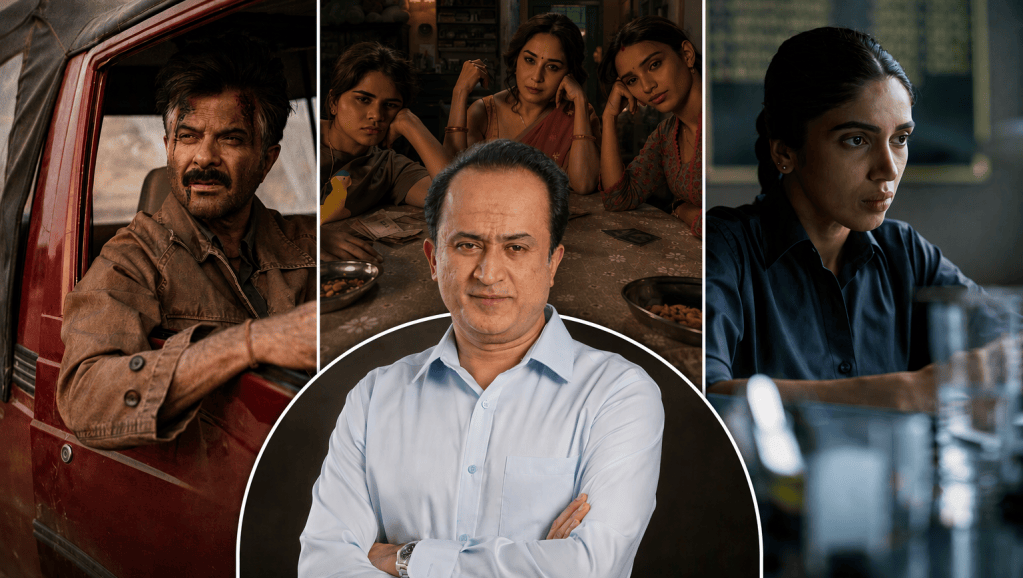
Abundantia Entertainment, the Mumbai production house run by Vikram Malhotra, is turning its AI division into a separate studio. The division, called AiOn, was set up in October 2025 as a creative unit inside the company. In an exclusive interview with Deadline, Malhotra said it will launch in 2027 as a fully fledged studio built natively around AI, making its own stories and content, from fully generated films to hybrid productions, and running the whole ecosystem around them the way Abundantia does for its conventional slate.
For now the arrangement is more modest than the announcement sounds. AiOn will stay inside Abundantia, and Malhotra will lead it himself while it is built up with its own identity and scope. He was careful about naming: it will keep being called AiOn, and "AiOn Studios" was only shorthand he used in conversation. The studio will lean on Abundantia's existing creative and production machinery and its network of contacts while it assembles a parallel one of its own, and he says it will need skill sets the company does not yet have.
His case for a separate studio rests on where he thinks the talent will come from. Malhotra argues that workflows are turning hybrid, and that the ability to run AI at studio scale will not be found only inside the traditional media and entertainment system. He describes the result as a meeting of technology and art. He also points to two earlier shake-ups: technology-company money flowing into entertainment, and streaming changing how stories reach audiences. AiOn, in his telling, is meant to capture the next wave of creators that technology produces.
The evidence he offers is a change in his inbox. Over the past six months, he says, he has had roughly three times as many story pitches as before from people who have never written or made films and have no ties to the conventional industry. In his view AI lets such people test ideas, refine a pitch, build an audio-visual package around it and even add music. He cites Curry Barker, the director behind Obsession, and Kane Parsons, who made Backrooms, as examples of outsiders breaking through, and expects AI studios to push that kind of democratisation further.
Malhotra is explicit that the storyteller stays human, though the person's background may look very different from the industry norm. He says AiOn describes itself as human-first and AI-empowered, and that he is watching that play out in real time. He also says smartphone-level exposure to AI among Indians under 35 is close to universal, so he no longer has to sell the concept. A year or eighteen months ago he was talking about upskilling writers and directors; now, he says, people have moved quickly along the learning curve. Distribution through YouTube, Instagram and WhatsApp, he adds, is wearing down the gatekeepers, although finding such creators often means going to them rather than waiting.
On strategy, he insists AI is a priority for Abundantia and not merely a way to cut costs and save time. He calls it an amplifier of imagination and an accelerator of growth, and he frames its main business value around risk. Audience taste is unpredictable, and he says no technology removes that. The question the company asked was whether AI can lower the cost of getting something wrong, help it understand how and where it goes wrong, and turn the lessons into a repeatable process. He compares the approach to how the company handled earlier shifts, including remote working during COVID and being the first film-industry player to move into streaming in India, and says Abundantia has been working with AI in its own way for about two years.
Two projects show where the work stands. Chiranjeevi Hanuman is finishing its readiness phase. Jai Santoshi Mata: Sukh Sampatti Daata is a hybrid production set to go on the floors early next year, with world-building and AI generation work already under way. Malhotra says the company learned a lot from making Chiranjeevi Hanuman and is applying it as it moves Jai Santoshi Mata and two further films into production, while looking for new filmmaking voices and running consumer research. He also stresses that AiOn is meant to use AI across the whole value chain, which is what separates a studio from the creative division it is today.
The studio also builds on a partnership signed earlier in the year. In February Abundantia teamed up with the AI video company InVideo to launch a film studio planning a slate of five films over a few years, and InVideo is also working with AiOn. Malhotra says that collaboration is bearing fruit: two films are under way, one close to starting production, and three more scripts are in development with filmmakers, timelines and budgets already attached.
Behind the AI push sits a conventional business. Malhotra founded Abundantia in 2013 after leaving Viacom18 Motion Pictures, where he was chief operating officer, and a shorter stint at Balaji Motion Pictures. Its credits include Baby, Airlift, Toilet: Ek Prem Katha, Shakuntala Devi, Sherni and the Chhorii films, plus the Prime Video series Breathe. This year brought Maa Behen on Netflix, Subedaar on Prime Video and the Prime Video series Daldal. Maa Behen topped Netflix India's trending films in its first week in June and reached second place among non-English films worldwide.
Mindset is the other theme he returns to. Before building an AI team, workflow or film, he says, a company needs an AI mindset, and he tells his staff to think about timelines, opportunity and economics the way a technology business would while keeping blue-sky thinking in the stories themselves. He describes the volume of pitches from creators under 30 as phenomenal, and recalls hearing one the day before that no one raised inside the conventional system would have come up with. The challenge, as he sees it, is identifying the right voices and building an institution around them rather than treating each as a one-off project.
Malhotra describes the company's founding idea as building around studio economics instead of project economics, an institution rather than a string of one-off films. He says that in 2013 he saw a gap between the supply of progressive, high-quality content and demand from a younger, more evolved audience, and Abundantia was built to fill it. In 2026 that approach has produced three releases, one film and one series on Prime Video and one film on Netflix, with theatrical work lined up, more projects for the two streamers and several titles in development. His stated principles are to put the customer at the centre, let creativity set the pace and keep changing the kinds of stories told. AiOn is meant to carry that outlook into AI-native production, and he presents the move as the next step in a pattern of absorbing technological change early rather than a departure from it.
The conventional side of the slate is in development too. Malhotra says both of this year's films, Subedaar and Maa Behen, were built around strong central characters and worlds that can be expanded, and that director Suresh Triveni imagined them as larger than a single outing. Development on follow-ups is under way, though he cautions that a sequel needs a solid reason of its own and cannot lean on the original. Subedaar, an action drama with Anil Kapoor as an older ex-serviceman taking on the system, marked the actor's first action lead in 23 years; Malhotra says Kapoor agreed almost before being asked, and that Maa Behen is a Hindi black comedy with Madhuri Dixit and Triptii Dimri.
Malhotra also gave a read on the wider Indian market, which he calls demanding and highly value-conscious. He says cinema-going has bounced back this year, with some films finding no ceiling and others failing with no floor, and that audiences reward novelty. Streamers and buyers, he says, are tightening their focus on engagement and return rather than buying content to fill slots, which he sees as a healthy correction. For AI in film, the news is that a mid-sized Indian producer with a hit streaming slate is willing to give its AI arm separate standing, with its first full launch targeted for next year.