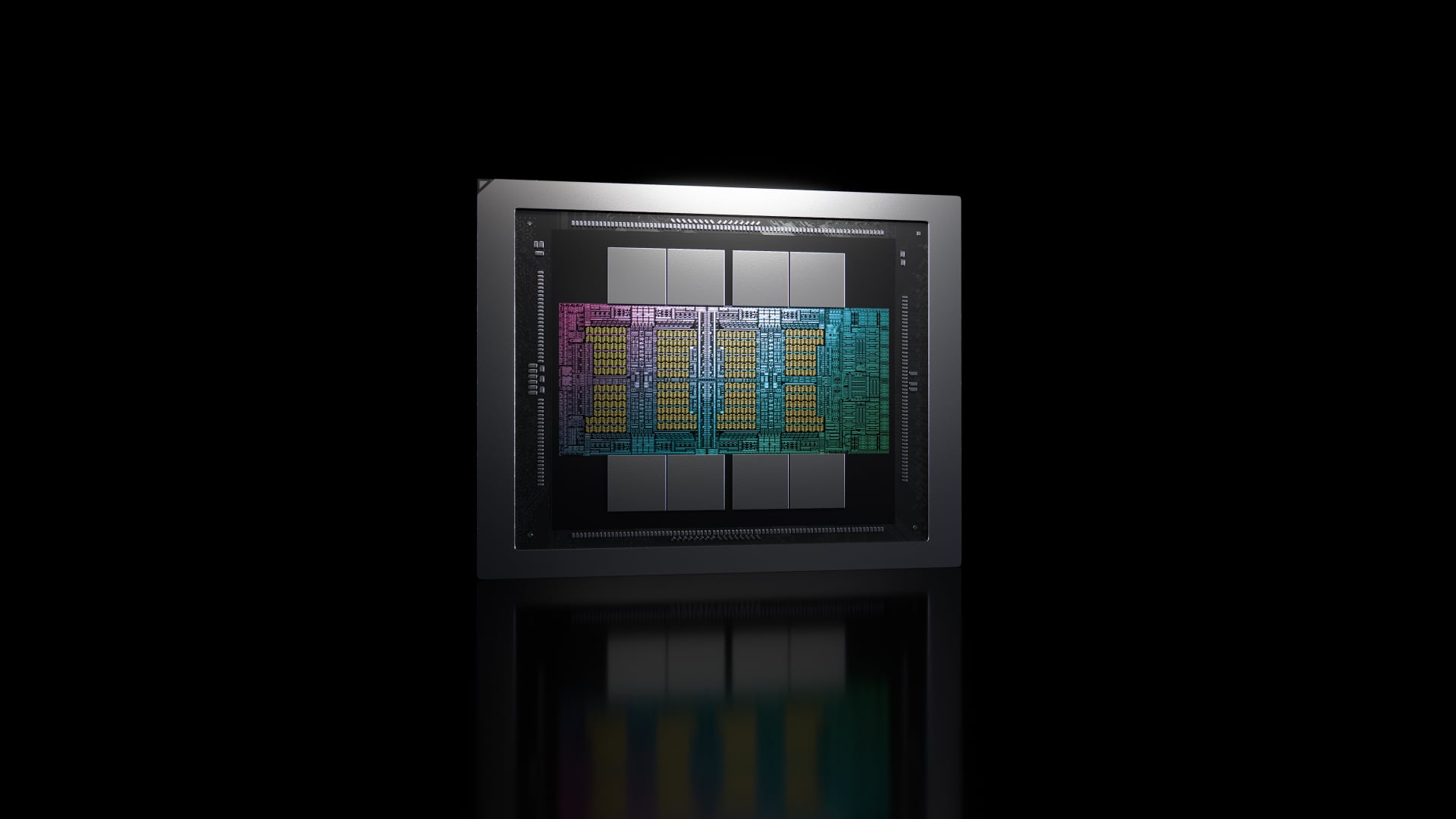
Nvidia used the SC26 supercomputing conference in Chicago on 16 November to preview Rubin HPC, a GPU aimed at scientific computing, engineering simulation and data analysis. It carries more than 50,000 CUDA cores against 28,672 on the standard Rubin GPU, which Nvidia says is the most on any single chip it has made. The part adds a new generation of NVLink, the current one running at 3.6 TB/s per GPU, and hardware for sparse data, the zero-heavy datasets common in biology and astrophysics. It ships in 2028, and no memory size, power draw or price was given. Nvidia's pitch is that faster simulation matters more now that AI agents run simulations to test ideas and choose what to try next, so the hardware speeds up the loop between hypothesis and result.
“Nemotron for Science gives researchers open models, scientific data and post-training recipes to build specialized agents that reason through scientific problems and use CUDA-X accelerated tools to turn ideas into discoveries.”
Ian Buck, Nvidia vice president of hyperscale and high-performance computing, in Nvidia's announcement, to SiliconANGLE · siliconangle.com ↗
Alongside the chip came a rack-scale system built on Nvidia's Vera CPU: 192 processors, about 300TB of memory, 1PB of storage and over 200TB/s of memory bandwidth, liquid-cooled. Dell, HPE, Lenovo and Supermicro are due to sell it from early 2027. On the OpenFOAM fluid-dynamics benchmark Nvidia reports 1.9 times the speed and 2.4 times the performance per watt of x86 chips. Germany's DKRZ climate centre has picked the Vera CPUs for its HLRE-5 machine, due in early 2028, which is meant to run two global 5km climate simulations at once.
New CUDA-X libraries covered several fields. cuPhoton.xBeam cut radio-telescope correlation for the Event Horizon Telescope from over a month to eight minutes, and cuPhoton.xLens analyses fusion plasma simulations while they run. cuPotential speeds existing molecular simulation software by up to three times, and the cuSpa library for spatial cell maps is now open source, with Memorial Sloan Kettering seeing it run 900 times faster than on CPUs. CUDA-Q gained a qubit error-mitigation algorithm, and Nvidia, IBM and Fermilab plan a modular quantum co-design platform on DGX B200 systems.

Techstrong's lead image for Nvidia's supercomputing and science announcements
Image: Techstrong.ai
On the software side, Nemotron for Science packages open models, scientific data and post-training recipes for building research agents. It builds on the Nemotron 3.5 Super VL model, introduced the month before, with 124 billion parameters of which roughly a tenth are active, and a LitmusBench v0.2 test of nearly 50,000 chemistry-reasoning questions, with the model and dataset on Hugging Face. Sweden's KTH reports its Nemotron agent fixed 81% of faulty GROMACS setups overnight on one DGX Spark, and Argonne National Laboratory uses it for protein-therapeutics work.
About Nvidia
Nvidia's Rubin architecture was launched at CES in January 2026, when the company said it was in production and would ramp in the second half of the year. Rubin systems were slated for HPE's Blue Lion and Berkeley Lab's Doudna supercomputers.
Nvidia had already pitched the platform to scientists. At the ISC conference in June 2026 it presented Vera Rubin for science, citing more than 7 exaflops of AI performance and 5 petaflops of native FP64 across up to 144 GPUs, with NERSC's Dell-built Doudna system as a flagship customer.
8
Models indexed
Models on AIPopDB
The announcements marked 20 years since CUDA reached the HPC community at SC06. They landed days after Jensen Huang left the chief executive's job, with Colette Kress interim chief ahead of an earnings call the next day.
Sources · 2