Nvidia has released Nemotron 3.5 Transcribe, an open-weight speech model that does transcription, translation, speaker labelling and questions about a recording in one pass, steered by plain-text prompts. It arrived on 28 October 2026 with Granary v2, a larger open speech dataset, and fine-tuning tools and guides. Weights and data are on Hugging Face.
The model transcribes 40 languages, translates 31 of them to or from English and labels speakers in 13, for recordings up to an hour with as many as eight voices. It has 30 billion parameters, about 4 billion active per step, and runs on a single Nvidia GPU, from DGX Spark and Jetson AGX Thor up to Blackwell data-centre chips. Nvidia says an RTX PRO 6000 Blackwell Server Edition at NVFP4 precision gets through 100 hours of audio in under three minutes.
“A transcript can capture every spoken word and still leave users or applications wondering who said what, how to translate it, or how to format domain-specific jargon.”
Nvidia, in its Hugging Face blog post, in its Hugging Face blog post · huggingface.co ↗
On benchmarks it ranks first among open-weight models on the English Open ASR Leaderboard, at a 5.33% average word error rate. On Artificial Analysis it scores 2.81%, near the 2.77% of Voxtral Small, which has roughly six times the active parameters. It placed first of 14 systems on VoiceArena's overlapping-speech test and had the lowest error rate on David AI's speaker-attribution benchmark, just ahead of Nvidia's own Nemotron 3 Diarization.
A case study on speech from Indian doctors and students shows what fine-tuning adds. The error rate started at 30.8% and fell to 11.8% after about 14 GPU hours on one GB300. The cost was slightly worse general English and weaker brand-name drugs, so Nvidia advises keeping at least 100 verified real recordings for testing.
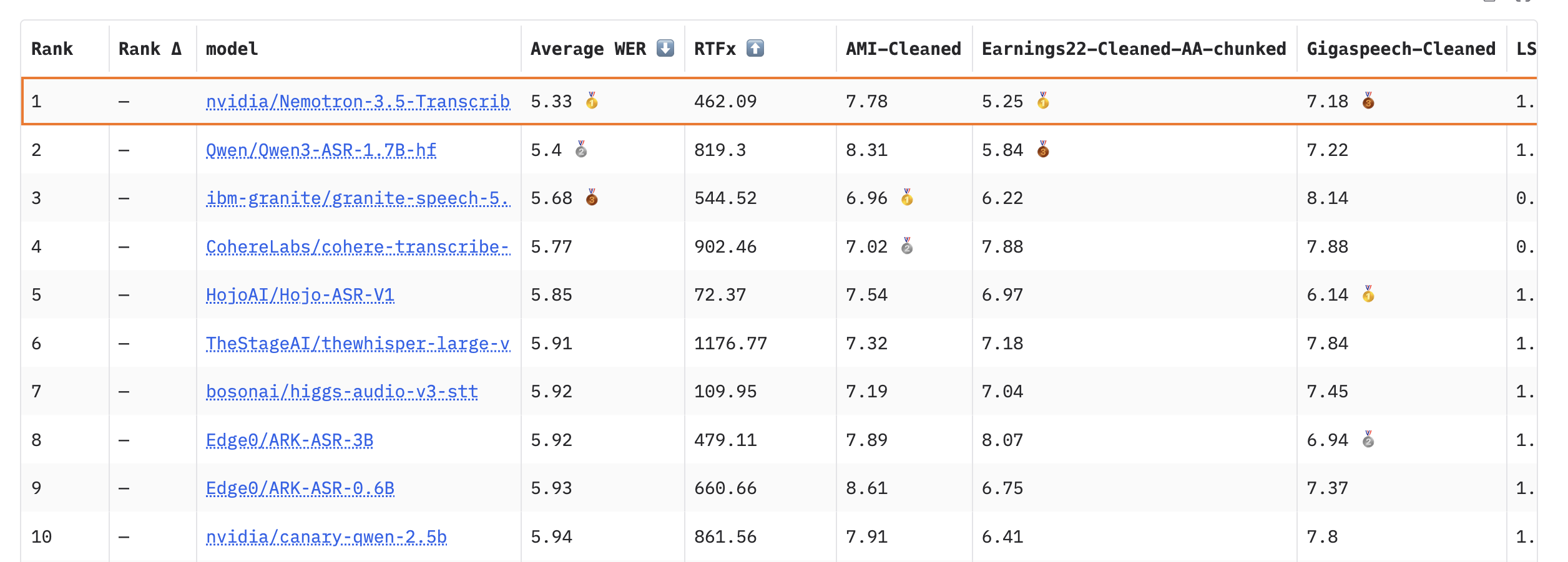
Hugging Face's English Open ASR leaderboard table, with Nemotron 3.5 Transcribe first among open-weight models at a 5.33% average word error rate
Image: Hugging Face (Nvidia blog post)
Granary v2 covers 48 languages, up from 25, with three transcript styles per recording: verbatim, digits, and cleaned of filler words. The model can produce any of them on request.
About Nemotron 3.5 Transcribe
Nemotron 3.5 Transcribe is Nvidia's open-weight, promptable speech model, which puts transcription, speaker attribution, translation and audio question answering into one checkpoint. It belongs to Nvidia's Nemotron speech collection on Hugging Face and was trained with data prepared by the NeMo Curator pipeline behind Granary v2.
Granary, Nvidia's open multilingual speech dataset built with Carnegie Mellon University and Fondazione Bruno Kessler, came out in August 2025, covering nearly all EU languages plus Russian and Ukrainian. Alongside it Nvidia released the Canary-1b-v2 and parakeet-tdt-0.6b-v3 models, its earlier open transcription line. In September 2026 it followed with Nemotron 3 Diarization, an open model that tells up to eight speakers apart but does not transcribe.
Oct 2026
Released
Nvidia frames it as replacing the usual chain of detecting speech, transcribing, labelling speakers and answering questions. Diarization arrived in September as a separate model needing a transcriber such as Parakeet. Audio question answering was trained in English only, and Nvidia tells users to spot-check names, speaker changes and answers against the recording. Quantized versions and local NeMo-Speech.cpp deployment are due soon. The launch lands in a busy stretch for voice AI, with Mistral's Voxtral 3, ElevenLabs' Realtime and Salesforce's Launa-Omni all out recently.
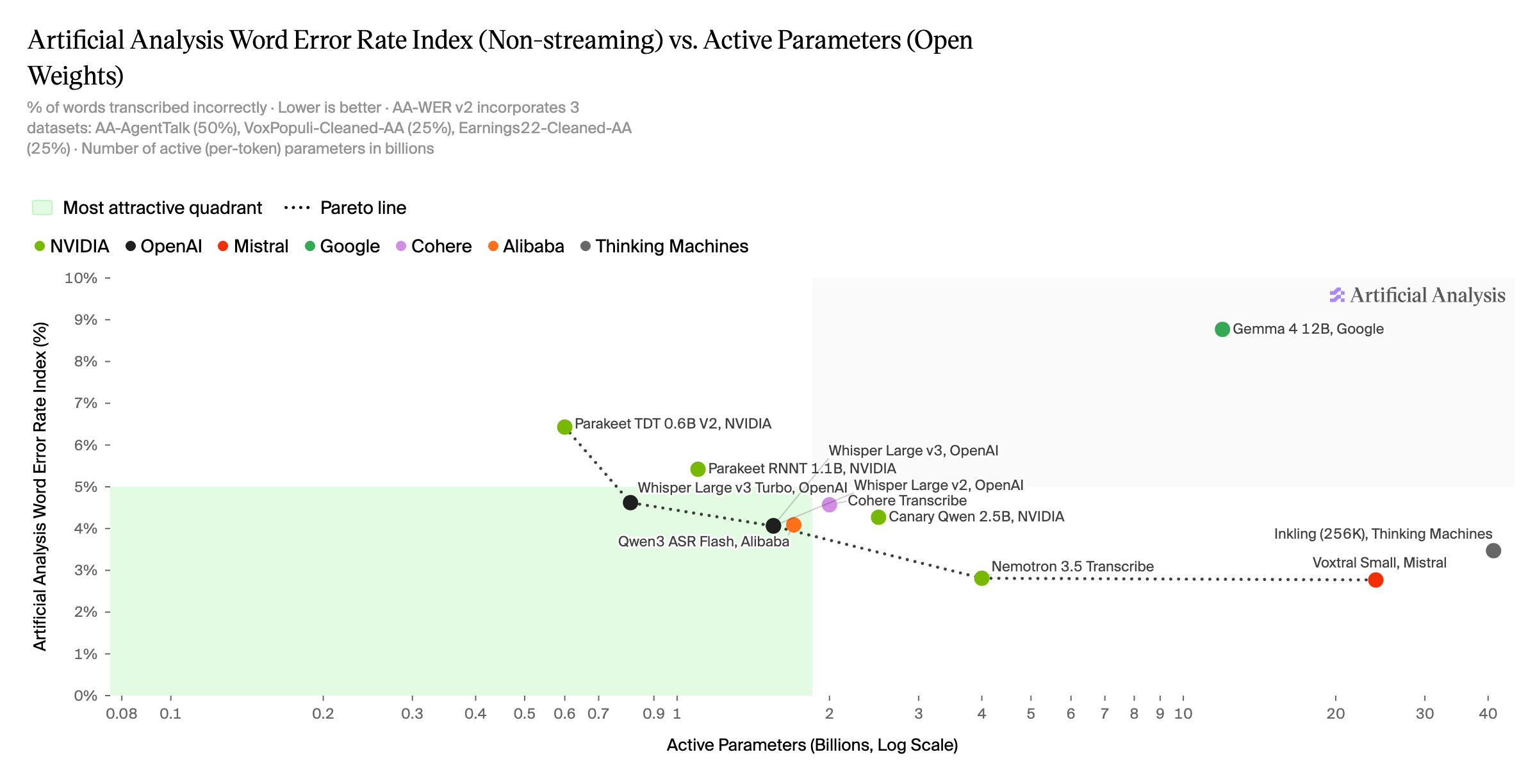
Artificial Analysis chart of word error rate against active parameters, placing the model on the open-weight frontier at about 4B active parameters
Artificial Analysis · Image: Hugging Face (Nvidia blog post)
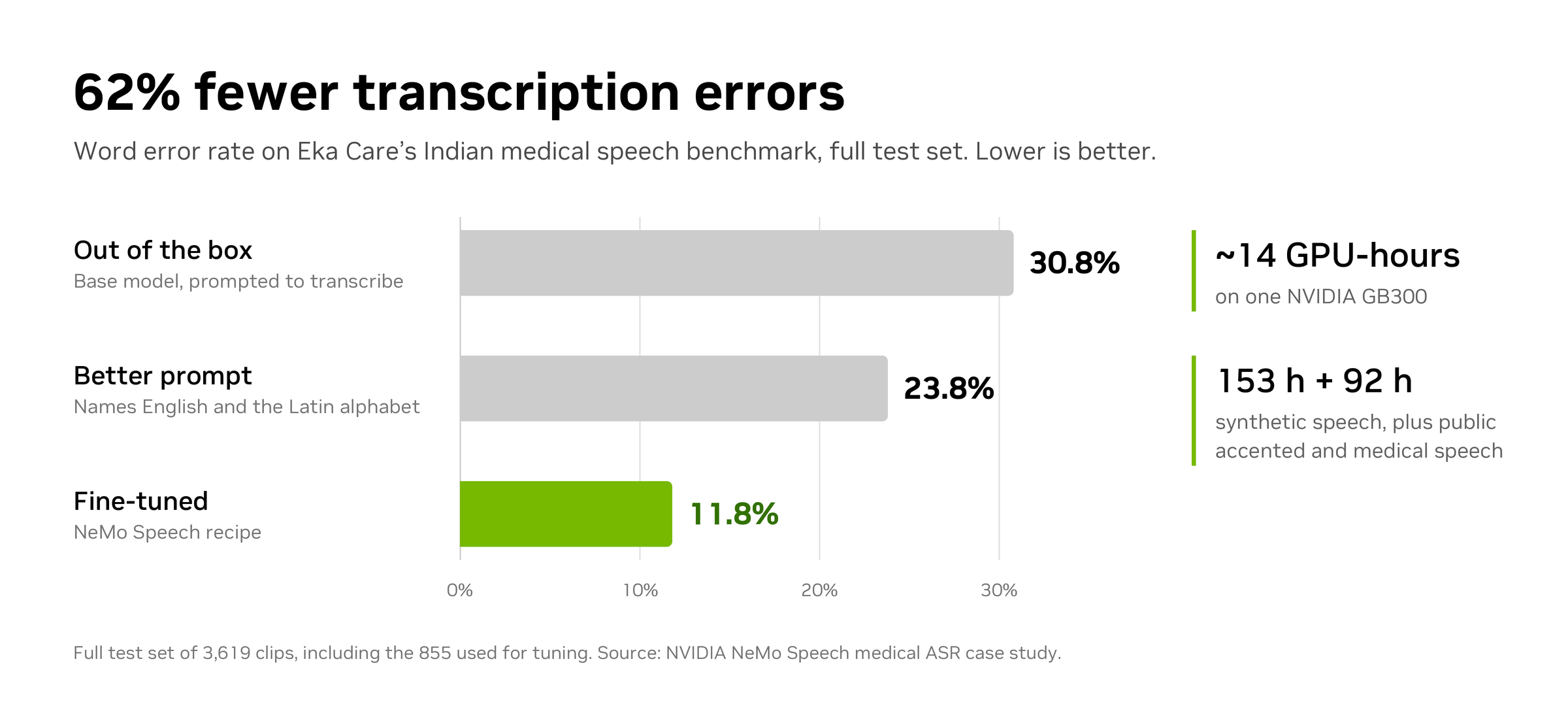
Bar chart of the Indian medical speech case study, with word error rate falling from 30.8% to 23.8% by prompting and to 11.8% after fine-tuning
Image: Hugging Face (Nvidia blog post)
Sources · 3