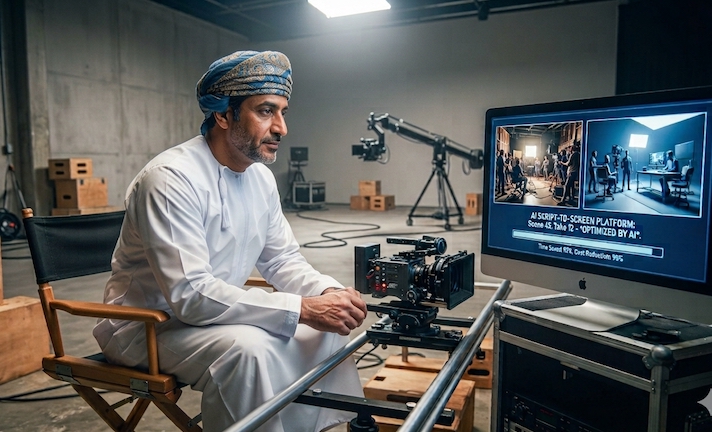
Oman now has a festival for AI-made cinema. Muscat Daily reports that the Muscat AI Film Festival (MAIFF) launched in August and opened for submissions in September. Workshops and creative labs follow in October, the five top films screen publicly at VOX Cinemas in November, and awards will be handed out at the Royal Opera House Muscat on 19 January 2027.
Entries can run to seven minutes and may be fully AI-generated or hybrids that mix conventional footage with generated shots and effects. The festival is open to international creators, who get 40 per cent off entry fees, and its theme is humans, machines and cultures meeting through storytelling. Organisers also pitch it as a training scheme. They aim to teach more than 1,000 Omanis AI-assisted filmmaking and bring 40 to 60 local small businesses into a festival village, and they expect Snapchat and the New York Film Academy to take part. Four animal mascots (a turtle, an oryx, a falcon and a camel) give it a local face.
Huzaifa Ubaid, an organiser and head of commercial at national events company EATCo, told the paper the festival is meant to add a tool to filmmaking, not replace the traditional craft. He said the idea came to him after the 1 Billion Summit in January. For him, the festival shows that this kind of experiment is now happening in Muscat itself rather than somewhere else.
The festival's founding generative-AI partner is RMZ, a Muscat-based service billed as Oman's first all-in-one generative media platform. A five-person team led by visual artist Haitham Busafi, whose work has been exhibited in Europe, started shaping it in 2024. Users turn text prompts, images or product links into short social clips or more cinematic videos of up to 30 seconds at 1080p.
Instead of offering dozens of models, RMZ uses a short list that includes ByteDance's Seedance 2 and 2.5 and MiniMax, plus tools for upscaling and reference-based generation. Busafi said the list came from testing for facial consistency and physics, with regional needs such as Arabic appearance and dress in mind. ByteDance has given the platform 100,000 credits for a year. RMZ reports interest from students, colleges and ministries. It says teachers have used it to make 3D models of the heart and other organs for biology classes, and visual explainers of stock markets for business lessons. Busafi describes the platform as a way to democratise art so that anyone can tell a story, but says that freedom comes with a duty to learn storytelling through practice, study and experience.
The piece sets all this within an older argument about whether new technology kills film art. It recalls that colour stock, nonlinear editing and gimbals all met resistance and ended up widening what storytellers could do. The real risk, it argues, is people using AI without knowing lenses, cutting or the grammar of cinema: a director who has never heard of a J-cut can still make something that looks impressive and says nothing. At the same time, it sees AI as the next step in a line that runs from cheap DSLRs to desktop editing and YouTube, putting studio-grade tools in the hands of people who could never afford them. Busafi agrees: in his view the tools give access to skills, but the creative choices still have to come from a director with taste and training. The article ends on the same note, saying a camera never made everyone a filmmaker and AI will not make everyone a director.
Sources · 1