
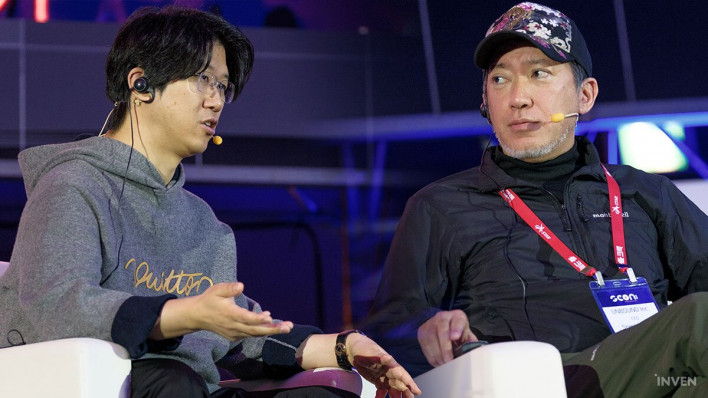
Shinji Mikami, the designer behind Resident Evil, told a Busan audience at G-Star 2026 that he sometimes wishes AI would vanish altogether, from games and from the world at large. In the same breath he said he is experimenting with it, because it can deliver higher quality inside a fixed budget. He spoke on the G-CON stage on 19 November alongside Kim Hyung-tae, the CEO of Shift Up, which bought Mikami's studio Unbound earlier this year.
The way Mikami uses it is narrow. He draws the 2D art himself, then has AI turn it into a 3D preview inside the game in roughly twenty minutes. Before that, modelers could spend close to a month on a model, only to discover it clashed with the 2D art and throw it away. He treats AI as a tool for carrying out a creator's vision, with the core work staying in human hands, and he admitted developers could lose jobs to it within five to ten years. Yonhap's account stresses a different side of the same remarks: he does not hand design over to AI, because people end up wasting time fixing what it produces, and nobody knows what the next five or ten years will bring.
“Not this one, let's try that.”
Kim Hyung-tae, CEO of Shift Up, on how AI drafts make rejecting concepts easier, at G-CON · invenglobal.com ↗
Mikami also expects conversational AI characters, non-player characters that react rather than recite canned lines, to turn up in games, casual ones first. He said Kim is a champion of AI while the Shift Up studio floor makes everything by hand, and that he felt sorry Kim is misunderstood.
Kim explained where that reputation came from. Shift Up released a music video for Stellar Blade: Blood Rain that drew backlash, and the lesson became an internal rule: "Handmade from start to finish." Even so, the studio uses AI in the middle of its pipeline for lighting tests, texture weathering, retopology, monster concept iteration, QA and code review, but not for writing stories. Kim said AI drafts make it easier to reject a concept, and that AI-made games feel homogenised, to the point where he can spot them on Steam.
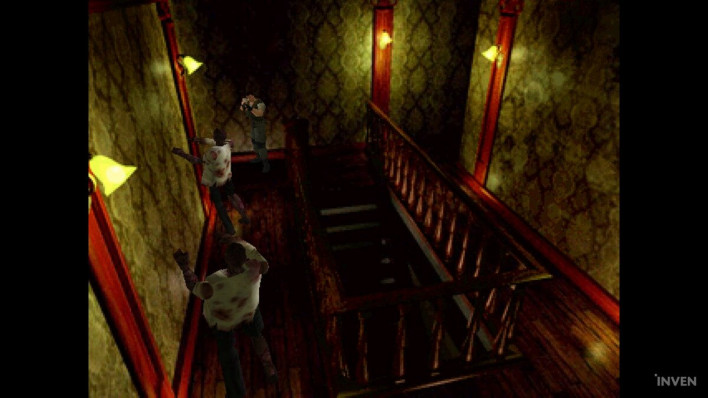
A frame of the original Resident Evil: a figure on a mansion staircase with zombies approaching, the game Mikami directed in 1996.
CAPCOM · Image: Inven Global
Looking ahead, Kim predicted that 2027 will bring a flood of AI-generated games that makes handcrafted titles stand out, and that low-quality AI games will disappear through self-correction. Shift Up's next project is a dense cyberpunk city whose crowds of NPCs are not yet where the team wants them, and he hinted at a project sitting between indie and mainstream. Unbound is working on an original IP that Kim called smaller than AAA. No dates were given, and he asked fans to watch for both studios' upcoming games.
About Shinji Mikami
Shinji Mikami is a Japanese game designer, director and producer, born on 11 August 1965, who joined Capcom in 1990 and is best known for creating Resident Evil. He founded the studio Unbound in 2022; it began operating in 2023 as an independent company making an original AAA game, and Shift Up fully acquired it in March 2026.
Mikami began developing the first Resident Evil in 1993, a haunted-mansion horror game released in 1996, and later directed its 2002 remake and Resident Evil 4 in 2005. After directing God Hand in 2006 he made Vanquish in 2010, then founded Tango Gameworks, which ZeniMax acquired in October 2010. Its first game, The Evil Within, came out in October 2014.
TheGamer, which picked the story up on 20 November from Inven's coverage, set it against a wider split in the industry. It lists Take-Two, Naughty Dog and Dead Space's Glen Schofield among those open to AI, and Masahiro Sakurai and Nier's Yoko Taro among critics, the latter having spoken of a "hell of fighting over remaining jobs." The session also covered Resident Evil level design, such as setting ammo at 1.5 to 2 times the total enemy health.
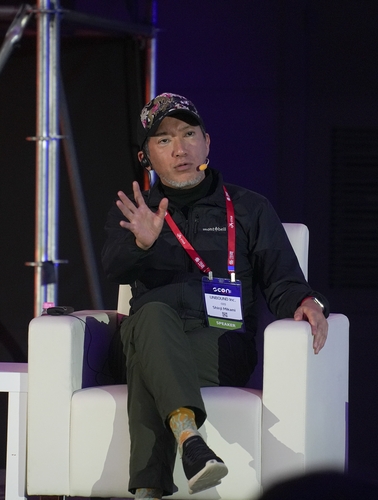
Mikami speaking on the G-CON stage in Busan on 19 November.
Yonhap News / Kim Ju-hwan · Image: Yonhap News (via Korea Center)
Comments