Microsoft used its Ignite conference on 17 November 2026 to roll out a batch of its own models alongside updates to Foundry, its platform for building and running AI agents. The models come from Microsoft AI and cover coding, images, security and routing decisions, while the Foundry changes aim to help agents keep improving after they are deployed.
On the platform side, Foundry IQ now supplies an enterprise knowledge graph out of the box, spanning unstructured data and application data. Observability tools now feed learning loops, with internal evaluations that set baselines for quality, safety, latency and cost. Human annotations, in preview, let experts rate and comment on agent traces, and supported models can be adapted to an organisation's own data with reinforcement learning while Foundry supplies the compute. The model pool highlights the top 50 models behind a model router and an AI Gateway, drawn from a catalogue of more than 11,000 that includes OpenAI, Anthropic, Meta and Mistral AI.
“We've heard again and again from leaders that no one wants to pour their IQ into someone else's model.”
Microsoft AI, in its launch post, in its launch post · microsoft.ai ↗
Decision-1.1 is generally available. It handles classification, routing and prioritisation quickly, so bigger and pricier models are called only when needed. It is built on Google's Gemma 4 26B A4 base, adds image input and succeeds the October Decision-1. TestingCatalog reports a score of 68 on the Artificial Analysis Decision Index, up from 62, at $0.042 per million input tokens. Microsoft claims it is 50x faster and 79x cheaper than GPT-Sol 6.1 and is used by 4,000 customers.
The coding pair, MAI-Code-2 and MAI-Code-2-Flash, is generally available in GitHub, with Flash in preview in Foundry. Microsoft says Code 2 reaches 98% of GPT-6.1 Sol's coding quality at about 40% of the price, and 96% of Claude Opus 5.5 at 5%. Flash, it says, matches GPT-6 Luna at 65% of the price and Claude Haiku 5.5 at 20%. The company admits Code 2 is not yet tuned for science research or very long-horizon agent work, and says developers preferred its frontend output to GPT-6 Sol's 64% of the time. All of these are Microsoft's own comparisons.
Microsoft AI's hero image for the MAI Code 2 coding model
Image: Microsoft AI
MAI-Image-2.7 and MAI-Image-2.7-Flash enter preview. Microsoft says the first ranks first on Artificial Analysis image editing at a fifth of the price of GPT Image 2.6 Sunburst, and Flash costs about $10 per 1,000 images. MAI-Cyber-2-Flash is aimed at security work: it scores 92.3% on CyberGym-E2E against 91.5% for GPT-6 Astra, at under 2% of the cost per task, with a 1M-token context and $0.10 input and $0.50 output per million tokens. It arrives in preview in Codename MDASH, Microsoft's agentic code-security system, for eligible customers from mid-December, replacing the current model there, and its output tokens are 86% cheaper than Cyber 1.1 Flash.
About Microsoft
Microsoft's in-house model work is recent. Its AI unit, Microsoft AI, announced its first in-house models, MAI-Voice-1 and MAI-1-preview, on 28 August 2025; until then Microsoft's products had mostly used OpenAI's models.
On 13 October 2025 it announced MAI-Image-1, a text-to-image model. On 2 June 2026 Microsoft AI launched seven new MAI models, distributed through Foundry and through OpenRouter, Fireworks and Baseten, and said it trains its reasoning models from scratch without distilling them from other labs.
1
Models indexed
Models on AIPopDB
Several other pieces shipped alongside. MAI Realtime 1, a speech-to-speech model from $0.01 per audio minute, has interest registration open through MAI Labs. The Maia 200 accelerator is in production, at 1.7 times the tokens per watt, and MAI Licensed Weights lets customers run customised models inside their own Azure. As evidence for custom models, Microsoft points to AT&T, which built a MAI model for 5G network analytics that Microsoft says beat GPT-6.1 Sol at 50 times lower cost. The launch follows seven in-house MAI models released in June 2026, which also went to Foundry.
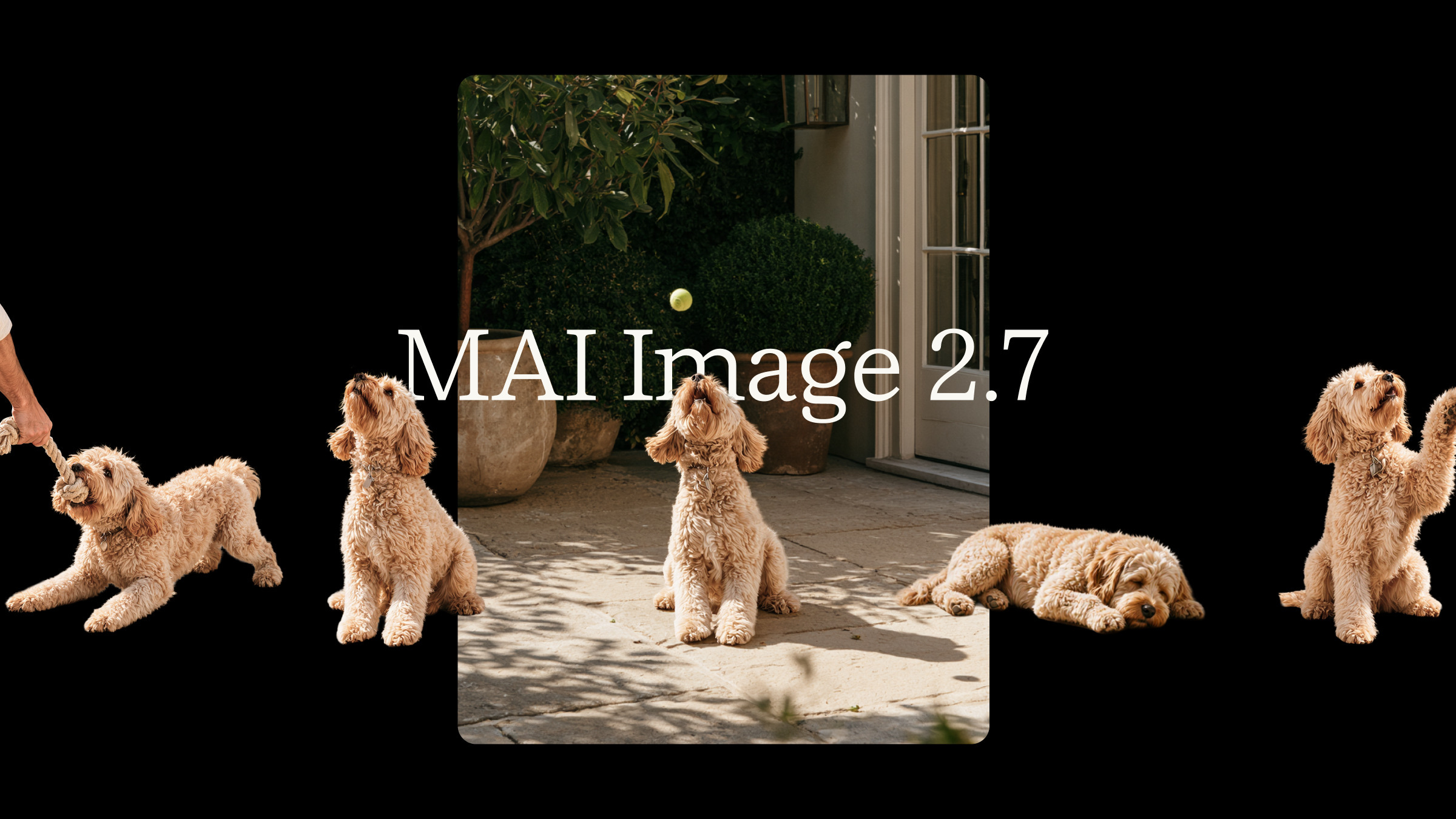
Microsoft AI's picture for the MAI Image 2.7 image model
Image: Microsoft AI

Microsoft AI's picture for the MAI Cyber 2 security model
Image: Microsoft AI