Meta released Muse Ember on 9 November, the smallest and most efficient model in its Muse family. It is built for the work agents repeat constantly: tool calls, coding subtasks, routing, extraction and parsing long documents. Frontier models often split a request into subtasks and hand them to cheaper agent models, and Ember targets that role. It is available on the Meta Model API as muse-ember-1.0 and in Muse Code, and also on Google Cloud and Oracle Cloud.
“What stood out in our testing was speed. Muse Ember ran up to 30% faster at the tail than the comparable model we tested”
Dane Knecht, CTO of Cloudflare, in Meta's announcement · research.meta.ai ↗
Pricing is $0.10 per million input tokens and $0.50 per million output tokens, with cached input at $0.004. The context window is 1 million tokens, with up to 512,000 tokens of output, and it takes text, images, audio and video natively. It is the first model Meta trained using Muse Wonder Full, though Meta did not say which part of the process Wonder handled.
The benchmark figures are vendor-reported. On the Artificial Analysis index at maximum reasoning, Ember scores 35.8 at about $0.136 a task, against 36.2 at $0.411 for Claude Haiku 5.5 and 27.8 at $0.152 for GPT-6 Luna. On AutomationBench-AA, 657 tasks across apps such as Gmail and Salesforce, it scores 37.8%, against 20.2% for Luna and 13.9% for Haiku. On Meta's internal Agents' Last Exam it reaches 61.6% against about 57% for both rivals, and on Terminal-Bench 4.0 it scores 40.9% against 39.2% for Haiku and 16.4% for Luna. It trails Haiku on FrontierCode 2.0, 27.2% against 34.9%. Against the larger Muse Spark 1.3 the index gap is a point, 36 against 37, at $0.14 a task rather than $2.39.
Header graphic of Meta's Muse Ember announcement post
Meta · Image: Meta
Meta claims more intelligence per dollar than Haiku or Luna at any reasoning setting, matching Haiku's best score at about a third of the cost. Meta says Ember beat the two rivals on seven of nine further benchmarks, all at the maximum setting, and that it matches Haiku's best score at roughly a third of the cost. Its cost comparisons are estimates at proposed pricing against rivals' list prices. Wonder, it says, plans the hardest problems, Spark suits coding and agent workflows, and Ember handles repeatable volume.
About Muse Ember
Muse Ember is the smallest and most efficient model in Meta's Muse family, built for the repetitive work of agents such as tool calls, coding subtasks, routing and extraction.
The family began with Muse Spark on 8 April 2026, the first model from Meta Superintelligence Labs. Muse Spark 1.1 followed on 9 July 2026 alongside a public preview of the Meta Model API, the channel Ember now ships on. On 12 October 2026 Meta introduced Muse Wonder and Muse Wonder Full, saying it would use them to develop specialised models.
Nov 2026
Released
Box, Cline, Oracle, Cloudflare and You.com were early partners, and Cloudflare's chief technology officer said Ember ran noticeably faster in its tests. Cline's founder pictured teams using it as the subagent in their harness. Meta says pre-release checks found risk below its high-risk thresholds for chemical and biological harm, cyberattacks and loss of control. Ember follows Muse Spark, the first Muse model in April, and Muse Wonder in October, and Muse Spark 1.1 followed in July, alongside a public preview of the Meta Model API that Ember now ships on. Meta says more efficient models are in training.
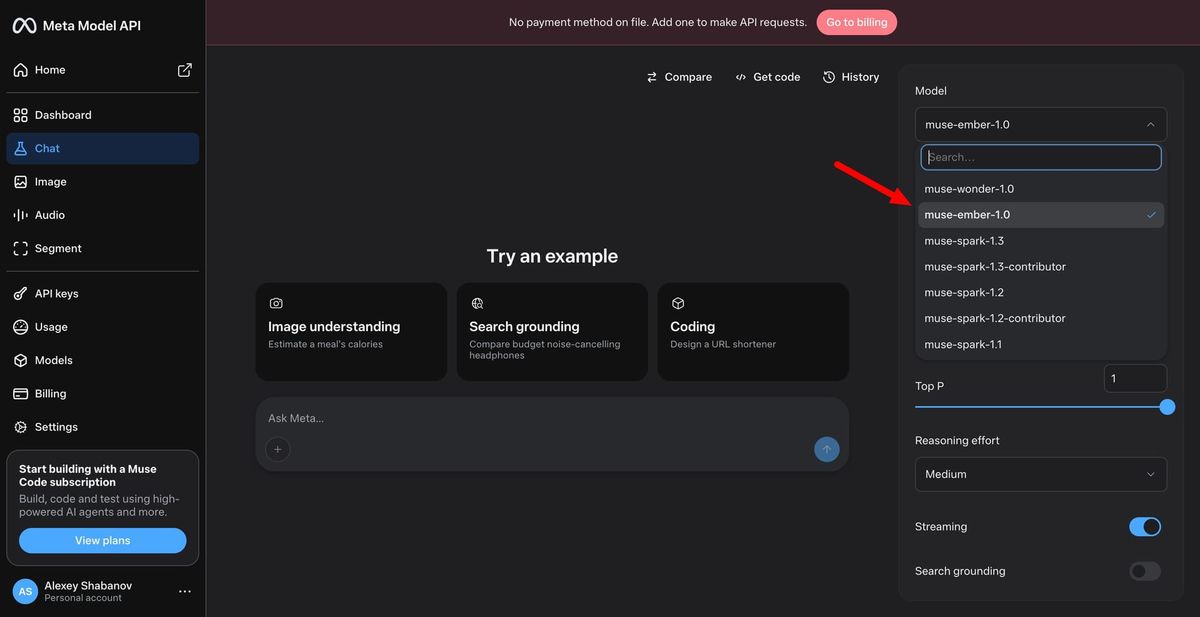
Screenshot of the Meta Model API page that lists Muse Ember
Image: TestingCatalog