Google has begun testing advertising inside AI Mode, its conversational search experience, for people who have linked their personal apps through a feature called Personal Intelligence. The company confirmed the test on 16 October 2026 in a statement to Search Engine Land. The confirmation matters because it undoes the line Google had held until now, which was that this connected experience would carry no ads.
The change first surfaced through Search Engine Roundtable, which spotted that Google's Search Help page for connected content apps had been revised. The new version includes a question about advertising that the earlier text did not have. That quiet edit, rather than an announcement, is how most people learned the connected experience was no longer ad-free.
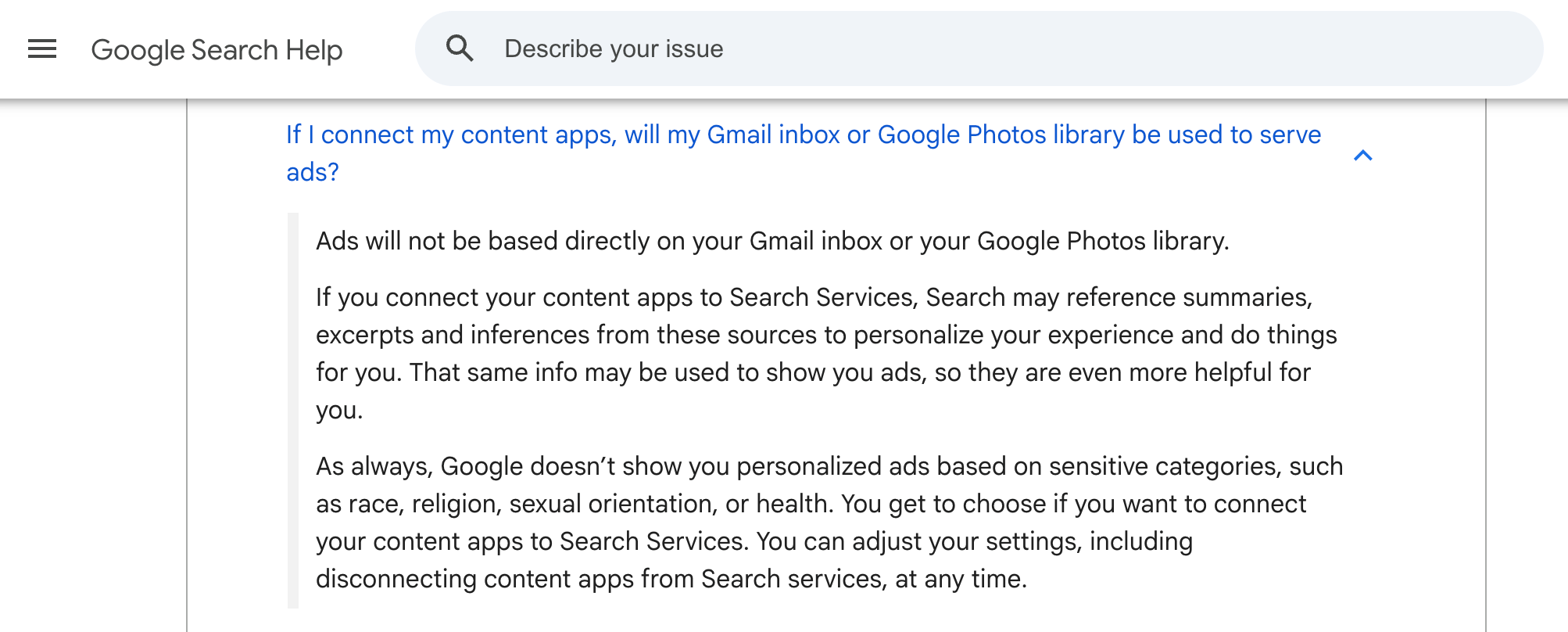
The help page tries to set limits on how the connected data is used. Google says ads are not built straight from the contents of a person's inbox or photo library. It adds, however, that summaries, excerpts and inferences drawn from that material can be used to tailor the experience and the ads shown. Google frames the benefit as ads that are more useful to the person seeing them.
There are stated exclusions. Sensitive categories, including race, religion, sexual orientation and health, are not used to personalise ads. Advertisers do not get access to the connected apps themselves. Connecting an app is optional, and a person can disconnect it again. Google also says ads continue to be matched to the query, the context of the answer and the user's interests.
“Ads will not be based directly on your Gmail inbox or your Google Photos library.”
Google Search Help page on connected content apps, in its Search Help documentation · seroundtable.com ↗
Eligibility is fairly broad. Connected apps are offered to users aged 18 and over in 188 countries and territories. Gmail is the main connection, and Calendar has been added for English-language users in the United States only. Other Workspace apps are described as coming soon. A personal Google account is required, and the Personalized Recommendations setting has to be switched on.
The reporting also points to what happens to the data beyond advertising. Material from connected apps, in the form of summaries and inferences, may be used to train Google's generative models. A subset of what AI Mode and Ask Maps process is also seen by human reviewers. Those lines sit in the same help documentation as the ads answer and are part of what a person agrees to when linking an app.
Google is also reshaping the controls around all this. Over the coming months it plans to replace Web & App Activity and Search Personalization with two new settings, Search Services History and Personalized Recommendations. The Keyword's report treats this as part of the same shift towards more personalised search, though it does not tie the renaming directly to the ads test.
How did it get here? Personal Intelligence arrived in January 2026 as a Labs feature for AI Pro and Ultra subscribers in the US who use English, and ads were not part of the discussion at that stage. In March it was opened to free US users. Google told Search Engine Land at that point that connected users saw no ads and that this was not changing for the moment, while also signalling that ads were expected to arrive at some point.
Reaction in the coverage centres on wording. The Keyword notes that the promise not to base ads "directly" on Gmail or Photos leaves room for targeting built on inferences from them, which is the gap critics are likely to press on. The help text offers no definition that would settle how far an inference can go before it counts as direct.
Relevant Audience, which writes from an advertising perspective, takes a more analytical line. It observes that no tool for advertisers has been announced, so there is no way yet to buy against this audience on purpose, and that the people in it are self-selected, since they chose to connect their accounts. Its reading is of an early, limited experiment rather than a finished ad product.
The wider backdrop is a race among AI assistants to find a way to pay for themselves. The Keyword mentions that OpenAI is moving towards ads in ChatGPT that draw on memory, which puts Google's test alongside a similar direction at its biggest rival. Both involve advertising that sits close to the personal context people give an assistant.
Much remains unanswered. Google has not said which markets the test covers, what ad formats will appear, or whether the ads will spread from AI Mode to other parts of its products. There are also no advertiser controls described and no schedule for a wider rollout. For now the clearest facts are the confirmation itself, the help page wording and the limits Google has written down.
For anyone who has linked, or is thinking of linking, Gmail or Google Photos to AI Mode, the practical point is that the arrangement has changed since they were told about it. Connection remains a choice that can be reversed, but what the connection can be used for now includes advertising built on derived information.