Google has launched Gemini 4 Hydrogen, a model it describes as fast and efficient, aimed at everyday coding and agentic work. It rolled out on 12 November 2026 and takes over the slot the Flash tier used to fill: Hydrogen is the successor to Gemini 3.8 Flash, and XDA Developers reported that it replaced Flash in its own model picker.
Hydrogen sits beneath the two frontier models in the Gemini 4 family, Gemini 4 Carbon and Gemini 4 Argon. Google says those two handle the hardest long-horizon reasoning, while Hydrogen is meant for quick execution, either on its own or as the part of a multi-model setup that carries out the work. Google DeepMind's Koray Kavukcuoglu framed it as a model for rapid execution across varied agentic workflows. Carbon had become generally available earlier in the same week, so the family now has a clear split of jobs: the larger models for deep, drawn-out reasoning and Hydrogen for the high-volume work that has to come back quickly. Google's pitch is that a team can use Hydrogen by itself for ordinary tasks or hand the heavy thinking to a bigger sibling and keep Hydrogen as the engine that acts on the result.
“Hydrogen brings cutting-edge intelligence to everyone.”
Koray Kavukcuoglu, SVP Google DeepMind and Chief AI Architect, Google, in Google's announcement · blog.google ↗
On price and size, Google lists $1.50 per million input tokens and $7.50 per million output tokens, charged at the same rate across the whole context window. It takes up to a million tokens of input and can return up to a million tokens of output. There are four thinking levels, low, medium, high (the default) and a new xhigh, and Antigravity shows an "Extra" tier alongside them.
The performance figures all come from Google. It says Hydrogen runs about 2.5 times faster than Gemini 3.8 Flash at default settings, scores 57% on Terminal-Bench 4.1 against 18.2% for that model, and makes up claims more than five times less often. On the Artificial Analysis Intelligence Index, Google reports 51 at default high thinking, one point above Argon's 50, and 54 at xhigh. Google also cites 58.8% on HLE-Diamond, first place on Vals Tax Agent Bench at 52.3%, a tie for first on Vals Legal Research Bench at 55.8%, and fifth on the arena.ai Agent Arena. For multimodal and agent tests it gives 53.4% on Multimodal Knowledge Agent and 71.6% on Agents' Last Exam v1.1. No independent reaction to these numbers had appeared in the reporting, so they are the company's own claims about its own model rather than verified results. Google presents the Index score as the notable one, since it puts a model aimed at everyday use level with, and on its higher setting ahead of, a frontier-tier sibling.
Google's account of safety is similarly its own. It says overreach in agent tasks fell by up to 81% and under-service by up to 79%, that misaligned actions are 12 times less frequent, and that the model showed a 96.7% internal honesty rate. It reports 99.9% chain-of-thought legibility across more than 200,000 audited turns, over 2.3 times more resilience on the Gray Swan prompt-injection benchmark, and false refusals under 0.4% on HealthBench Pro. As with the benchmark scores, these are results Google reports about its own model; the announcement does not point to outside audits of them.
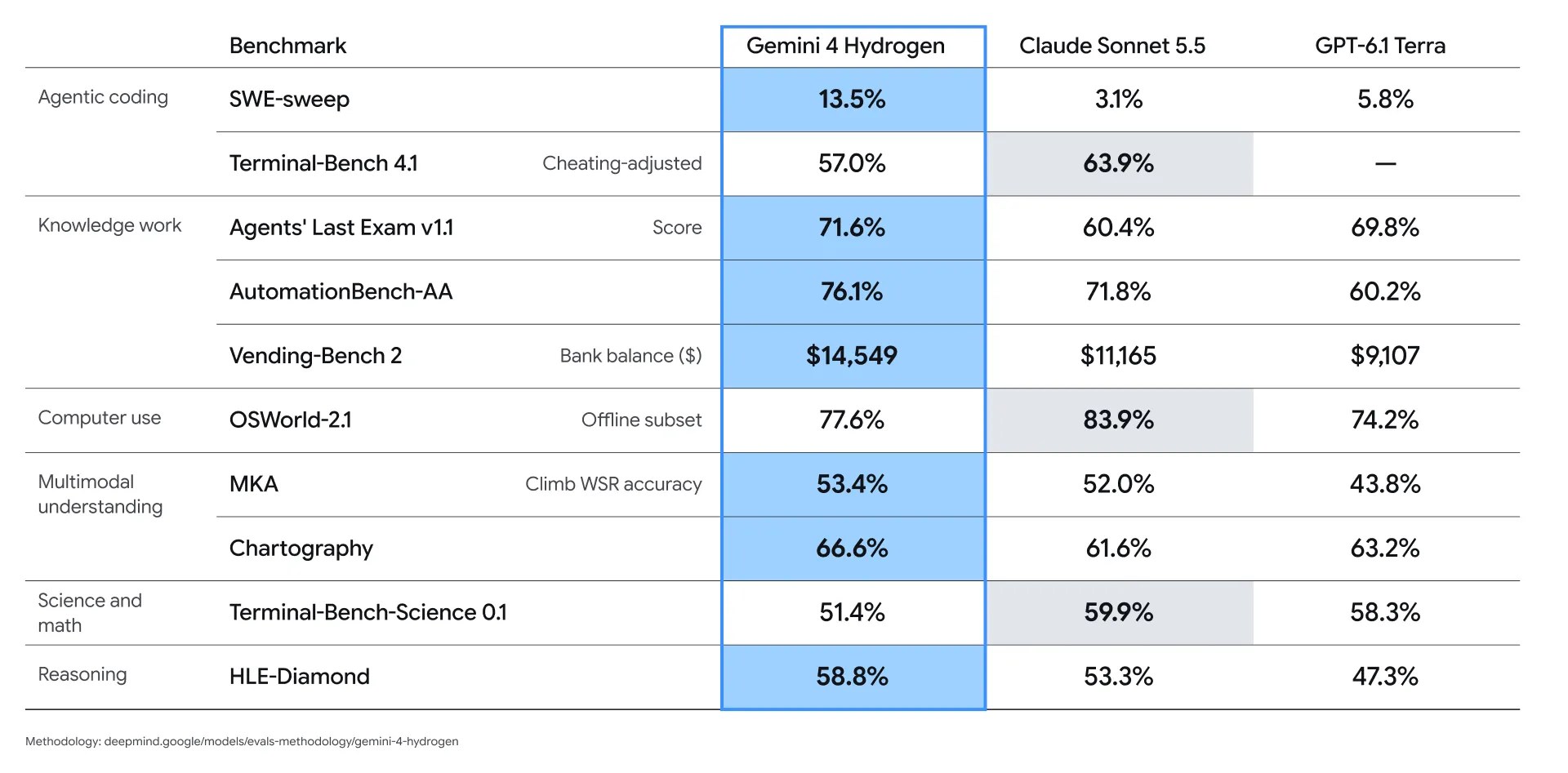
Google's benchmark table comparing Hydrogen with other models
Image: 9to5Google
For developers, Antigravity gains an Orchestrator that can move between Carbon and Hydrogen in the middle of a session. Google says that on Terminal-Bench 4.0 it used 24% less quota and finished 19% sooner. Partners testing Hydrogen on graph, SQL and data-heavy workflows saw it run two to 2.8 times faster than 3.8 Flash while using 12% to 23% fewer tokens, according to Google. Google's pitch to developers is that the savings come from the model finishing tasks with fewer tokens and less waiting, on top of the flat per-token price. The model is in Google AI Studio, the Gemini API, the paid tier of Android Studio and Gemini for business, with Antigravity open to paid AI Pro and Ultra subscribers.
Consumers see it in the Gemini app, where the picker labels it "Everyday help" and free users get it through Auto selection when it suits the request. Google says it is better at holding to the tone, format and rules a user sets, so that emails, study guides, rewrites and documents need less reworking, builds tables, and calls Connected Apps such as Airtable and Dropbox more reliably. In Search's AI Mode it is meant to cope with multi-part questions and typos and give more visual answers and a wider spread of links, thanks to improved query fan-out, the technique of splitting a question into several searches behind the scenes. XDA described the result as Google's best search-focused AI so far. In Sheets, Google says financial models are generated over 30% faster than before, starting with Pro and Ultra users. The Search change reaches every user, not only subscribers, which makes it the widest rollout in the launch; the Antigravity and Sheets features are the ones behind a paid plan.
About Gemini 4 Hydrogen
Gemini 4 Hydrogen is Google DeepMind's speed-and-efficiency model in the Gemini 4 family. It is built for everyday coding and agentic work and is priced below the frontier Gemini 4 Carbon and Argon models.
Its predecessor tier, Gemini 3.8 Flash, launched on 2 September 2026, the third Flash update in three months, with an introductory price of $0.75 per million input tokens until 31 December. Gemini 4 Carbon, the frontier model Hydrogen is paired with, was announced on 28 October 2026, two weeks after Argon, and ranked first on Artificial Analysis Intelligence Index v5.0 with a score of 59, according to the reporting at the time.
Nov 2026
Released
XDA's verdict on the launch was measured: it called Hydrogen a workhorse for general queries, not a model at the cutting edge, and it saw the change in practice when Flash disappeared from its model picker. It also took the launch as a sign that Google's later Flash successors will carry element names too, following the pattern set by Carbon, Argon and Hydrogen. The Flash line's recent history explains why the rename matters to existing users: the tier had been updated three times in a quarter, and its replacement arrives with a new name, a new price and a new top thinking level at once. The background is a fast cadence: Gemini 3.8 Flash arrived on 2 September, the third Flash update in three months, and Carbon was announced on 28 October, two weeks after Argon. Google's pages name no further date for anything still to come; Hydrogen is live now on the surfaces above, with Sheets and Antigravity limited to paid plans.
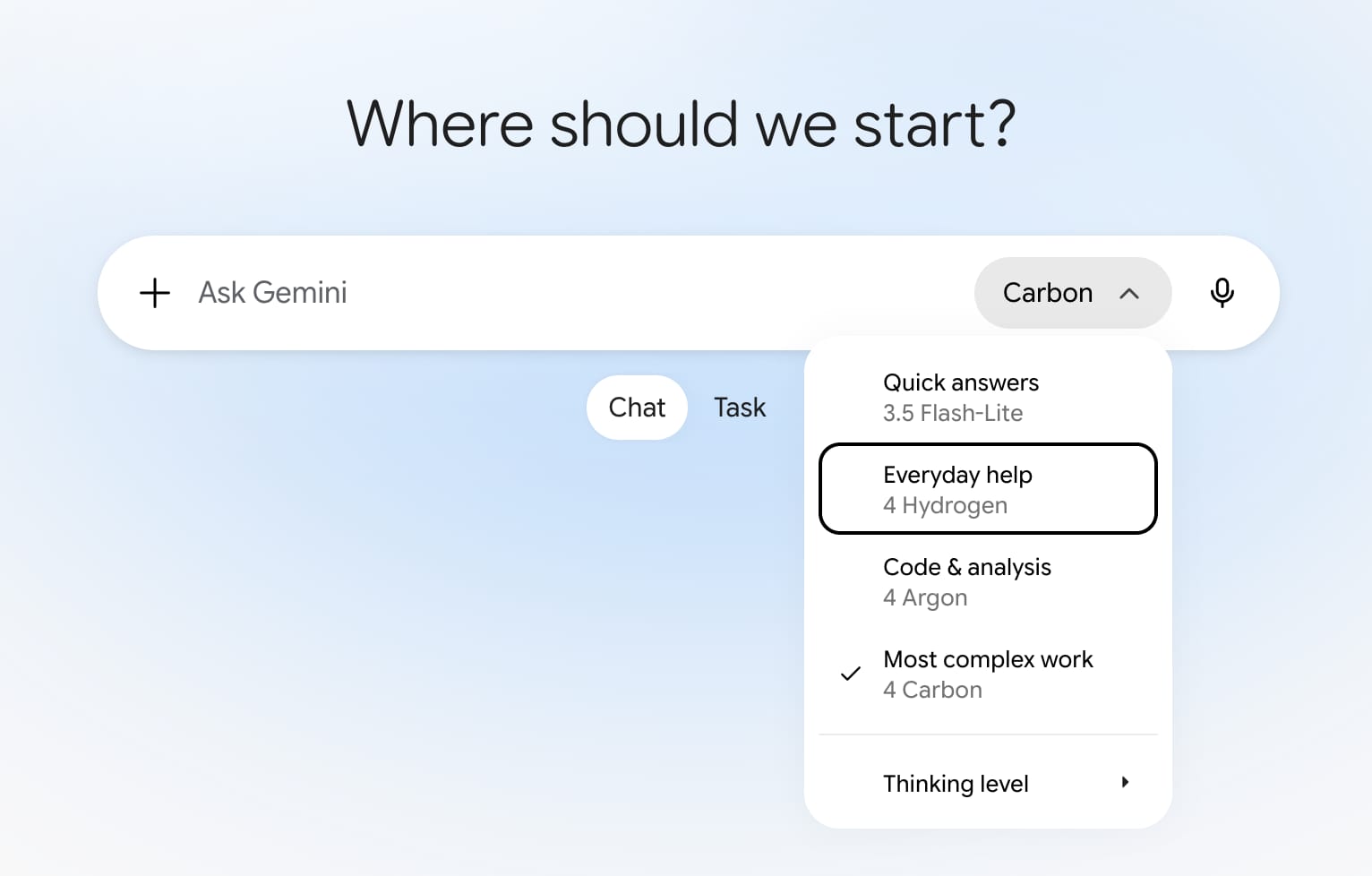
Gemini 4 Hydrogen in the Gemini app's model picker
Image: 9to5Google
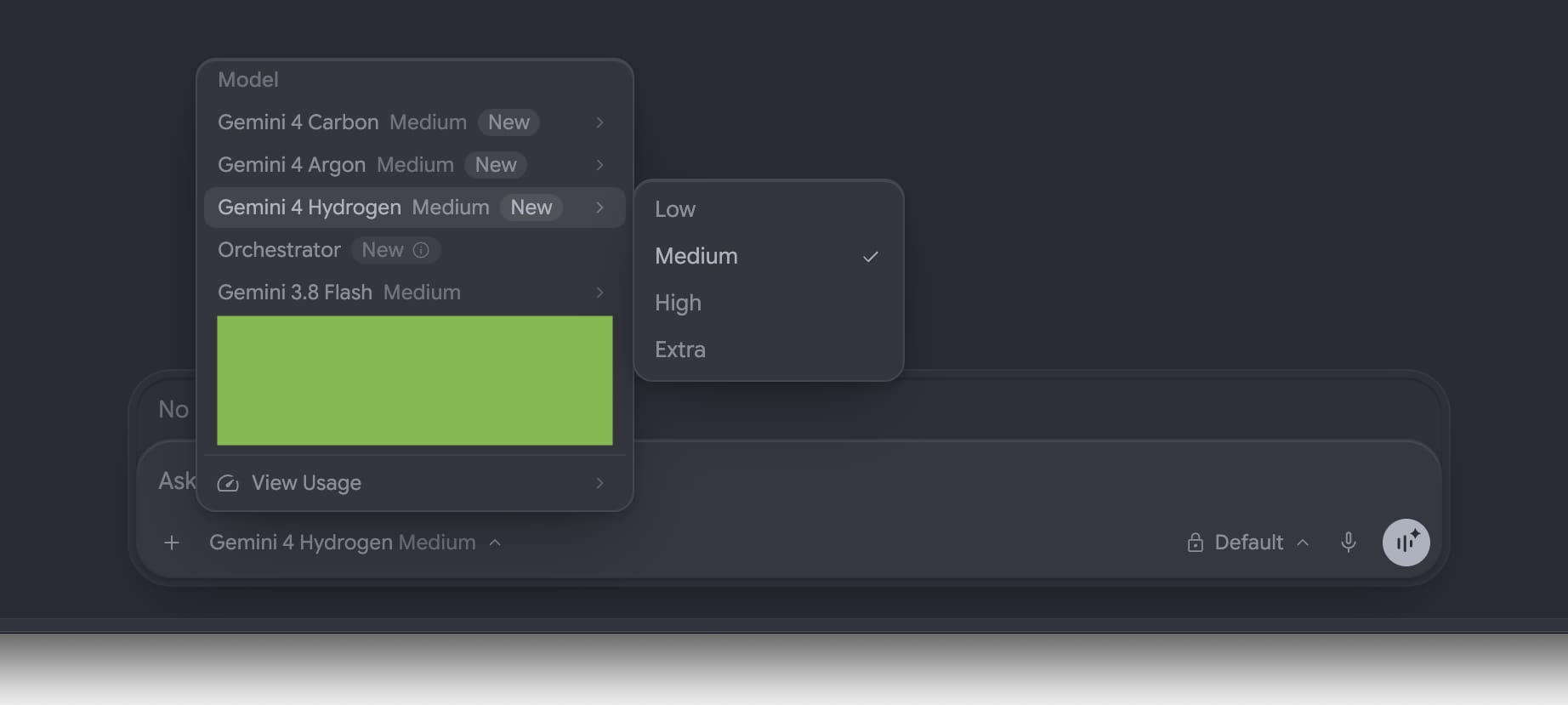
Hydrogen and the Orchestrator option in Google Antigravity
Image: 9to5Google
Sources · 3