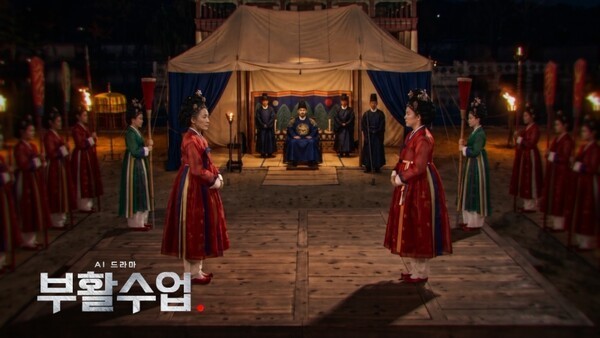
South Korean channel EBS1 aired an episode of AI Drama – Resurrection Class on 27 September about Bongi, a Joseon-era gisaeng whose performance of the old court dance Gokpamu is noted in the Annals of King Sejong, News Culture reports. The series uses AI to put historical figures on camera and build first-person accounts around the few facts recorded about them.
The episode is set in September 1425, after Bongi has danced for the king. Now older, she looks back on her early years as a government slave and her training at Gwanseupdogam, the court music institution, in gayageum, singing and dance. The drama shows her keeping an almost forgotten dance alive in her body for decades, within a system where talent brought visibility but not freedom. It does not romanticise that path: Bongi remembers watching other women bend to powerful men and learning early that praise did not change her status. Dance, in this telling, was the one thing she never let go of, and she becomes a kind of living archive of Gokpamu long after the culture around it had moved on.
The record itself says little beyond that she performed and was rewarded. The programme fills that gap with an imagined inner life, such as a childhood love of flowers and a sense of blooming after the royal performance, and frames her story through two dance terms, mutwoe for a retreating step and mujin for an advancing one, with the idea that stepping back need not mean staying there.
According to News Culture, the aim is not to pass off invented words as testimony but to offer a way into lives the chronicles reduced to a name, an occupation or a single incident. The series deliberately turns away from kings, ministers and scholars, whose lives are recorded in detail, toward people who survive only in fragments, and treats those fragments as a starting point. For Bongi, that means a name, a dance and a royal reward, from which the episode asks what it meant for a woman of her rank to master and preserve an art form.
Producers drew on the Annals entry, research on the gisaeng system and daily life in Joseon, and advice from Sogang University professor Seung-beom Gye. Bongi is the fourth subject in the show's run on ordinary Joseon people, after a performer, a young palace maid and a runaway slave. The episode aired on Sunday at 11 p.m. KST. News Culture notes that its English article was translated by hand and then proofread with the help of AI.
Sources · 1