Disney's annual Accelerator Demo Day, held in Burbank, California, put the company's 2026 startup cohort on stage, and all five of the companies are AI businesses. The program began in 2014, and each startup spends 15 weeks with Disney, mostly on ideas for the theme parks. Three of this year's five are already unicorns: Simile is valued at $2bn, FieldAI at $10bn and Physical Intelligence at $20bn.
The part closest to entertainment is OpenArt. Disney Music Group is testing AI lyric-video concepts with the San Francisco app, starting with "Go the Distance" from Hercules, the 1997 film. OpenArt turns a song's lyrics, mood and tone into a storyboard preview that Disney's team can edit, and Disney says a concept now takes hours rather than weeks. OpenArt's chief executive Coco Mao calls typing plain instructions to the software "vibe directing"; the app runs on several video models, among them Kling, Google's Veo and Seedream, and it uses a tool called CopySight to flag content that could infringe someone else's IP. Mao and John Qiao, both former Google engineers, founded the company in 2022; it now has nearly 100 staff and about 17 million monthly users.
“It just gives you a ton of flexibility, and from being a director who’s worked on many sets where budget was always the issue, timing was always the issue, this allows me to just focus on the story”
Dave Clark, chief creative officer, Promise, to TheWrap · thewrap.com ↗
Both sides keep expectations low. Mao describes the work as early exploration, and Disney says no AI lyric video has been released and has named no channel for one. The point of the test, as described, is to see how quickly a team can preview and revise a concept before anyone commits to a full production. The existing video for the song has about 280,000 views on YouTube. OpenArt could also let users make fan creations from Disney characters, an idea Disney has warmed to, though no date is given.
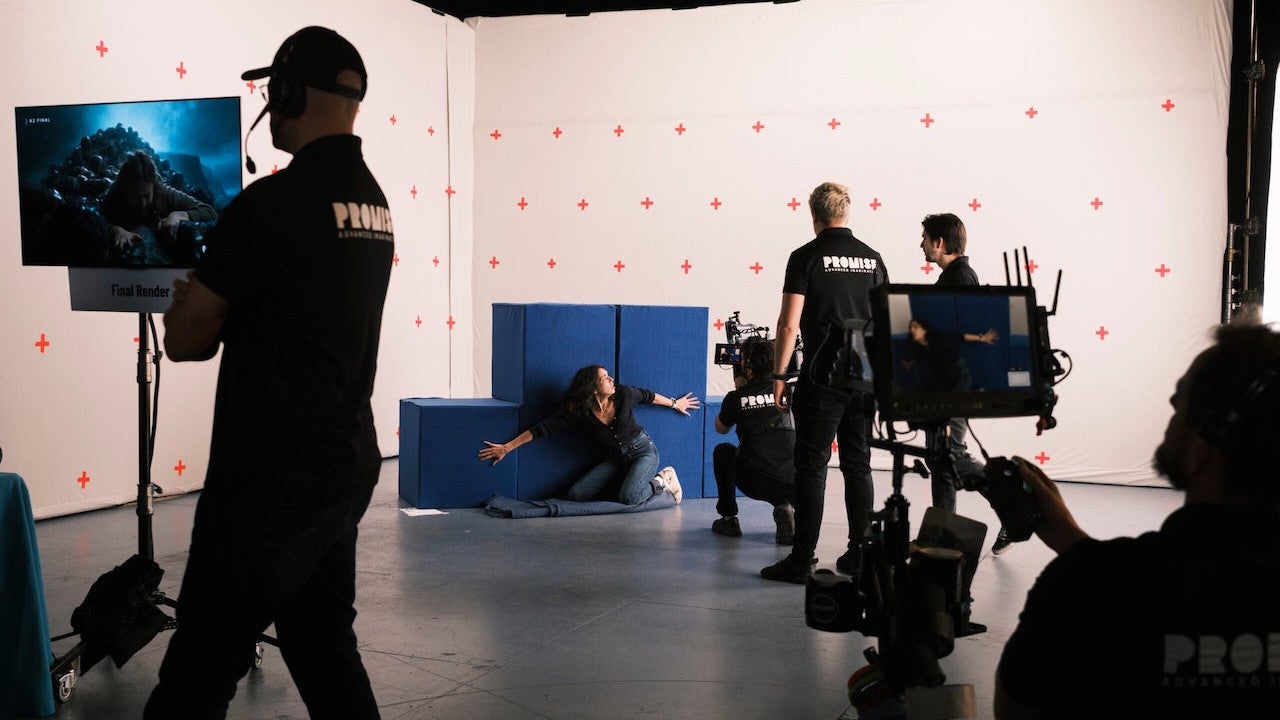
Promise showed what it calls gray-box filmmaking: a physical studio where AI fills in sets and props in near real time. Its operating system is called MUSE, and Doug Liman's Bitcoin: Killing Satoshi, with Gal Gadot, Pete Davidson, Casey Affleck and Isla Fisher, is cited as the first gray-box AI shoot. Promise's chief creative officer says the method lets a director stop worrying about budget and timing and concentrate on the story. Promise pitches it as a hybrid between live shooting and AI generation, and the demonstration at Demo Day showed that mix at work. Disney is not currently working on a gray-box project, so for now this is a showcase rather than a plan.
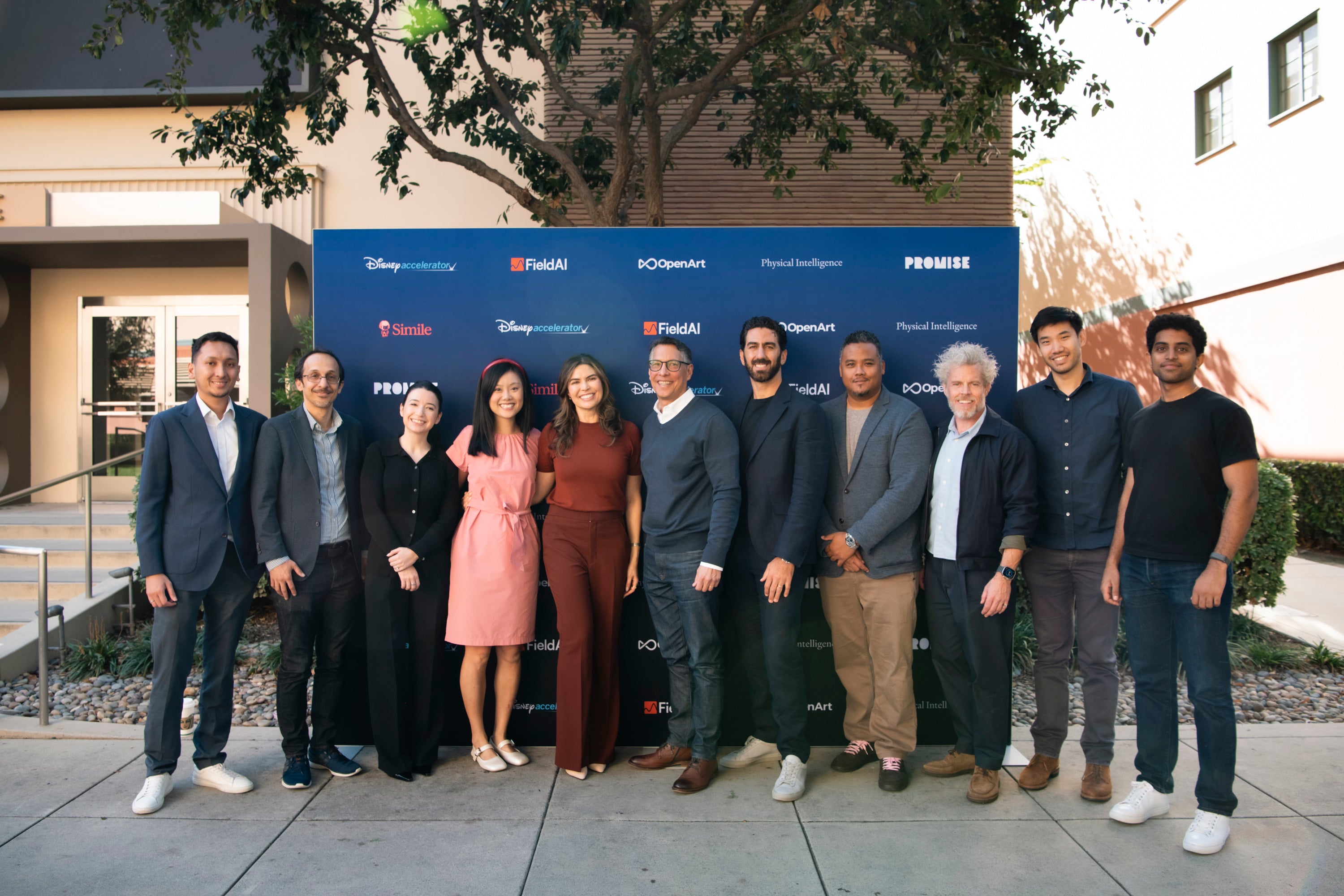
The five startups of the 2026 Disney Accelerator cohort posing with Disney executives Bonnie Rosen and David Min
Disney · Image: TheWrap
The other three startups point at the parks. FieldAI's chief executive hinted that its software already runs in the BDX droid at Galaxy's Edge, and a Boston Dynamics robot running FieldAI's code was on show. Physical Intelligence's robots clean and stack 3D glasses at a park, while Simile, one of the digital-twin tools on show, polls 20,000 to 50,000 people a week and keeps a database of about a million. Haddy, a returning member of the 2025 cohort, uses AI for robot arms that 3D-print large set pieces.
About OpenArt
OpenArt makes an AI creation app that turns a sentence, script or song into video. Coco Mao and John Qiao founded it in 2022 after working together at Google's Area 120 incubator, and it is based in San Francisco.
This is not the first time it has drawn attention for how fast it was growing. By August 2025 it had about 3 million monthly users and had launched a one-click story tool making one-minute videos, after raising $5 million, and it was on track for more than $20 million a year. In January 2026 it raised a $30 million Series A led by Canaan, with Basis Set Ventures and DCM.
2022
Founded
Disney's David Min, vice president of corporate innovation, says the aim is to fit AI into existing workflows with artists involved throughout, and CEO Josh D'Amaro says Disney will be very aggressive in exploring emerging technology for creators and personalised experiences. That sits beside a record of conflict and failed deals: Disney and Universal sued Midjourney in June 2025, and with Warner Bros. Discovery sued MiniMax that September. Disney sent ByteDance a cease-and-desist over Seedance 2.0 in February 2026, and its $1bn OpenAI investment and Sora licensing deal never closed before OpenAI shut Sora down in 2026. In September 2026 Disney also named Karandeep Anand, the former Character.AI chief executive, as its chief technology officer; Character.AI has since filed for bankruptcy, and Disney bid $20m for some of its IP licences.
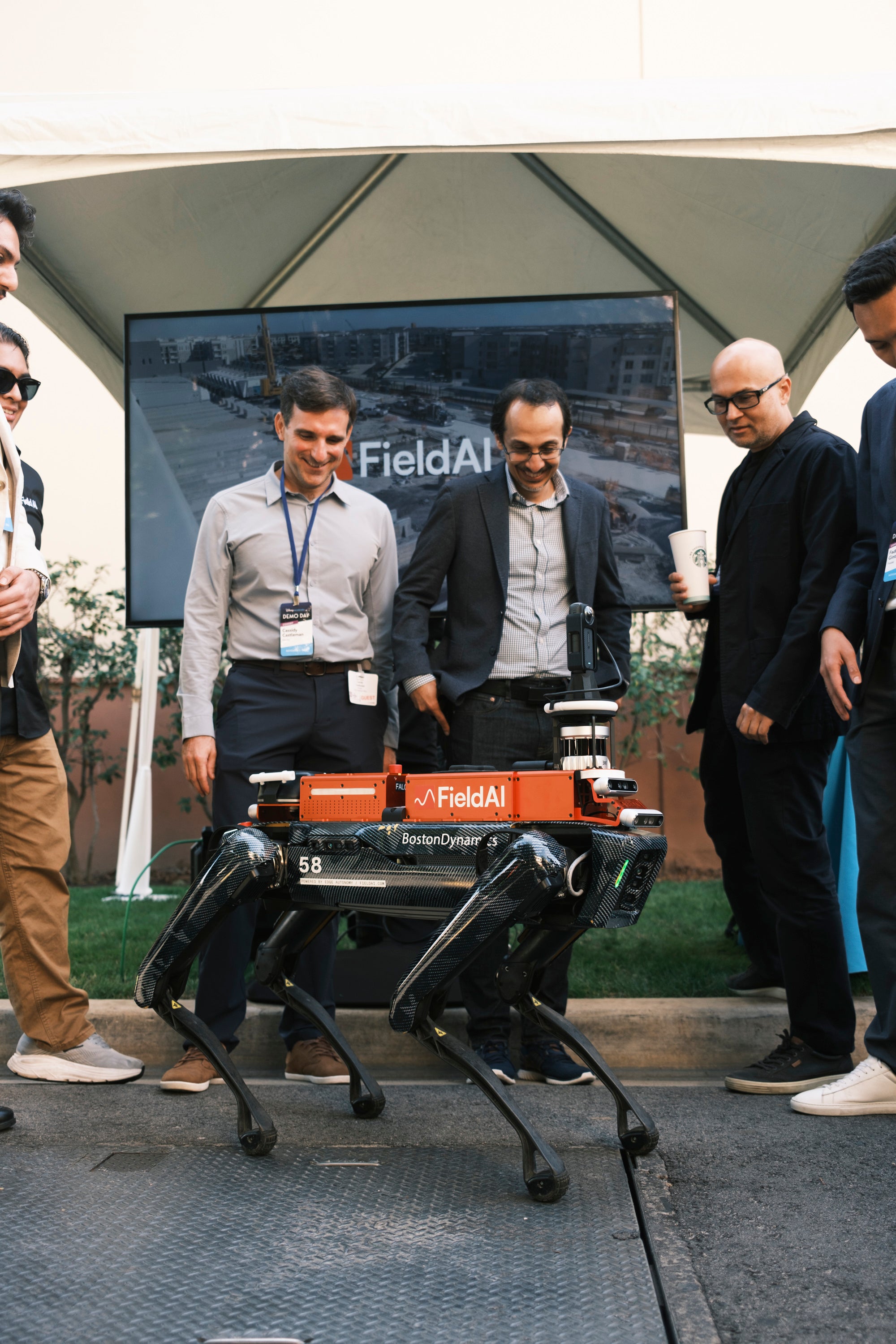
A Boston Dynamics robot running FieldAI's software on show at Demo Day
Disney · Image: TheWrap
Sources · 2