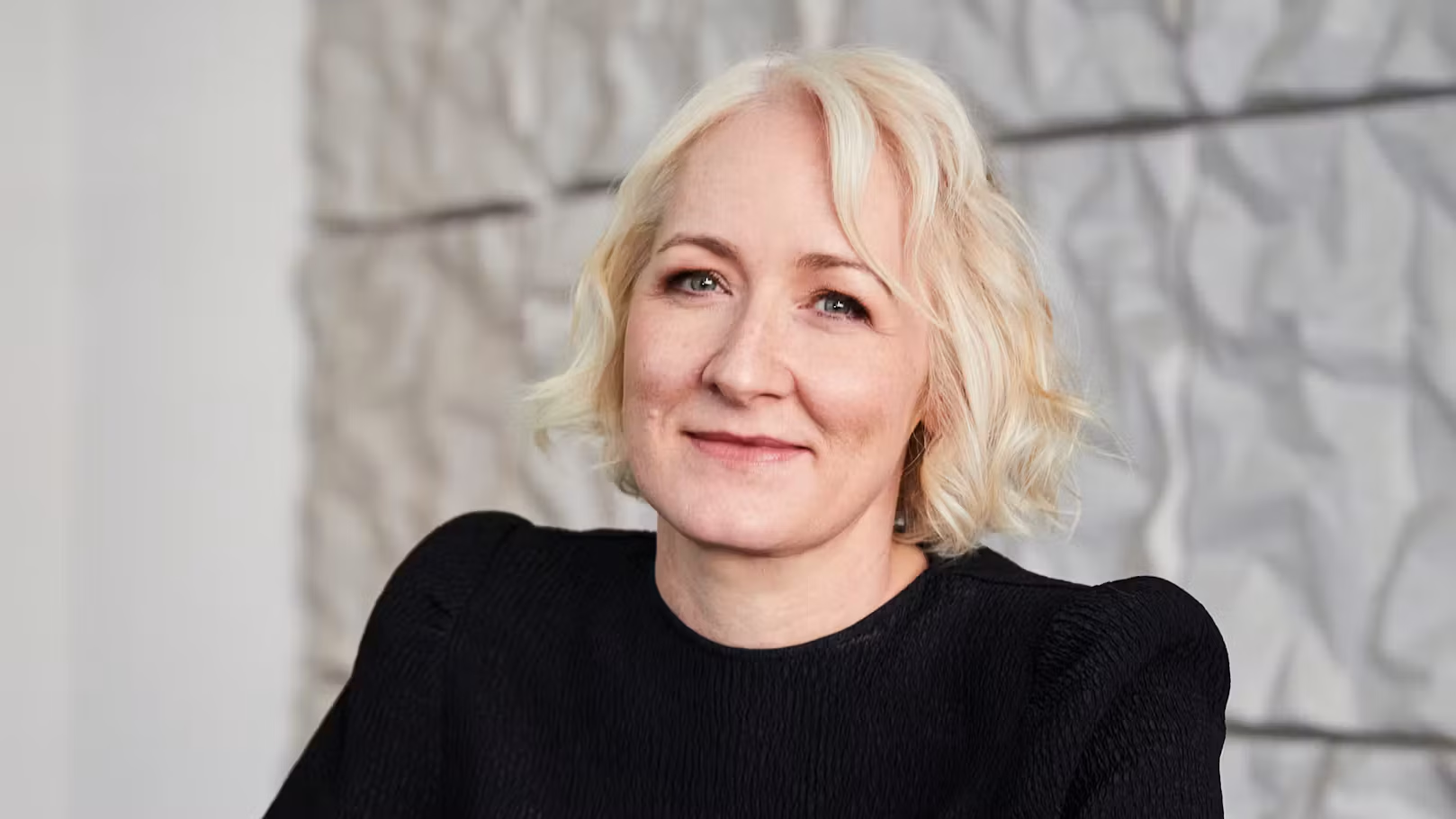
On Tuesday 6 October, Annabelle Herd, who runs both ARIA and PPCA, told Australia's Joint Select Committee on AI in Sydney that OpenAI and Anthropic want to build frontier models in the country without having to follow its copyright law. She said she was speaking for Australian and international artists, labels and distributors. Anthropic and OpenAI gave their own evidence to the committee the same day, and writers', musicians' and voice actors' groups also argued against loosening copyright to draw AI investment.
The committee heard the point in plain terms. Herd put the firms' size at the centre of her argument. She described each as worth more than USD 1 trillion, while the most recent funding rounds cited in the coverage valued Anthropic at USD 965bn (May) and OpenAI at USD 852bn (March). Her point was that companies of that scale can afford to pay for what they use. She also said four global deals, covering the three major labels and Merlin, are enough to license roughly 90% of the world's recordings, so a workable licensing route already exists.
Her argument also rejected the idea that the market has failed and needs the law bent to fix it. In her telling, the companies are asking Canberra for a favour that rights holders would otherwise be paid for, and she called rewriting national law around foreign commercial interests the opposite of sovereignty. Herd had welcomed the prime minister's July statement on creators' ownership for the same reason.
“There is clearly no market failure, just two foreign companies, each valued at over USD $1 trillion, asking Government for a free ride.”
Annabelle Herd, CEO of ARIA and PPCA, to the Joint Select Committee on AI · musicbusinessworldwide.com ↗
ARIA's stated position is not that training should stay out of Australia. Herd said it should happen on rights holders' terms, that legalising piracy is no answer, and that the companies should negotiate with creators instead of lobbying the prime minister. She also suggested that declining to license locally is a tactic to help the firms in their US lawsuits. A further concern was national treatment: any compensation scheme would have to pay overseas rights holders as well as Australian ones.
The two companies' own submissions point the other way. Anthropic told the committee that current Australian copyright rules are an obstacle. Its September filing floated a narrow, conditional approval for training, possibly paired with investment in Australian creators, while OpenAI asked for rules allowing models to learn from public information. The ask comes with infrastructure attached. Both tied their requests to data-centre plans: OpenAI has a memorandum with NEXTDC from December 2025, and Anthropic has a Queensland capacity deal from September, which is awaiting FIRB approval.
At the hearing, Anthropic's international envoy Jeff Bleich said the copyright settings would have to change even if licences were signed, since one cannot license the whole internet. No Australian licences have been announced, so the hearing did not show any deal in place that would answer ARIA's objection. OpenAI's Adam Cohen said the cumulative costs of any change should be made clear to investors at the start. The Australian Writers' Guild said creators want control over their work as well as payment, so treating money as the only issue is a step backwards.
The hearing follows a run of earlier moves. The government ruled out a text-and-data-mining exception in October 2025, and Albanese said on 15 July that creators keep ownership of their work. Reuters reported both firms' submissions on 22 September. Abroad, Anthropic settled Bartz v. Anthropic for USD 1.5bn last year and faces suits from music publishers, and the Third Circuit rejected a fair use defence in Thomson Reuters v. Ross on 29 September.
For AI developers weighing Australia as a place to train and host models, the hearing showed the music industry arguing that licences are available now, and showed two of the biggest AI firms still pressing for the law itself to move. How far the committee sides with either view will not be clear until it reports.
The committee is due to deliver its report by 30 November.