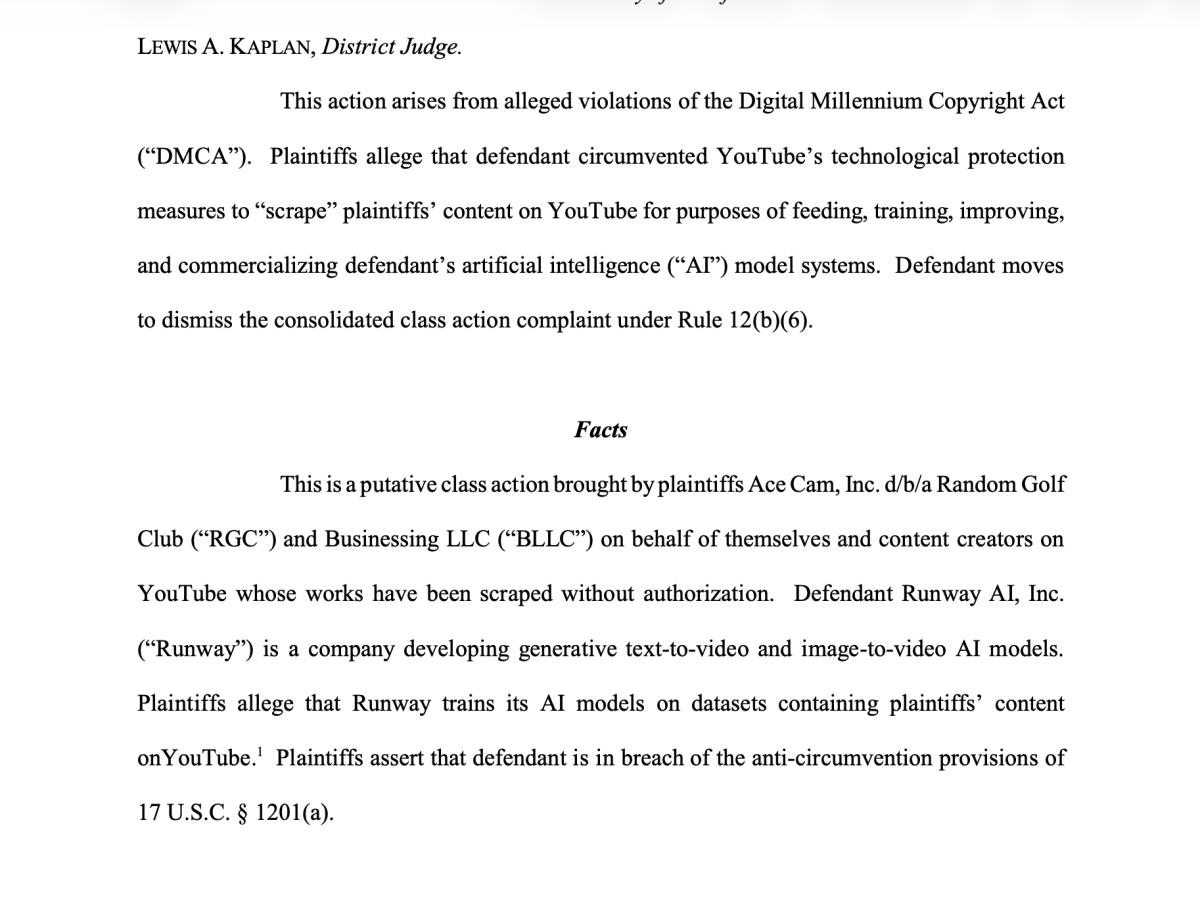
A federal judge in New York has refused to throw out a class action accusing Runway of breaking YouTube's technical protections to collect creators' videos for training its Gen-3 video model. US District Judge Lewis A. Kaplan denied Runway's motion to dismiss on 30 October 2026, in the consolidated case Ace Cam, Inc. v. Runway AI, Inc. The ruling decides nothing about whether training an AI system on the videos counts as copyright infringement; it only lets the case continue. A litigation tracker that linked the opinion described it as in line with other district judges' recent decisions.
The suit rests on a single claim, under section 1201 of the Digital Millennium Copyright Act, which bars getting around a measure that controls access to a copyrighted work. Creators do not need to have registered their videos with the Copyright Office to bring it, and the statute allows damages of $200 to $2,500 for each act of circumvention. The complaint lists five YouTube measures it says Runway defeated: a rolling cipher, IP blocks and rate limits, expiring session-bound links, CAPTCHAs aimed at automated traffic, and proof-of-origin tokens. It also leans on a leaked Runway spreadsheet naming roughly 3,968 channels and more than 100,000 videos. Those figures remain allegations, and the outlet that first reported the spreadsheet could not confirm every video was used in training.
“The public nature of content that has been uploaded to YouTube does not render it unprotected”
Judge Lewis A. Kaplan, S.D.N.Y., in his opinion, as quoted by Mubert · mubert.com ↗
Runway made two main arguments. Because anyone with a browser can watch a YouTube video, it said, YouTube's anti-download features are at most controls on copying, not on access. It also argued that creators had no authority over protections YouTube built itself. Kaplan rejected both. He wrote that the public nature of uploaded content does not leave it unprotected, treated scrambling and encryption as examples rather than a complete list of access controls, and found it plausible that creators authorised YouTube to deploy the locks by uploading. He relied partly on Yout v. RIAA, a 2022 Connecticut decision now on appeal at the Second Circuit, whose rulings cover New York.
The litigation has moved quickly. Ace Cam, which runs the Random Golf Club channel, sued in New York on 18 February 2026. David Vance Gardner filed in California five days later, and a company belonging to Ali Spagnola followed on 27 February. Interim co-lead class counsel Tom Kherkher and Gary Klinger were appointed on 27 March, Runway moved to dismiss in May, the Gardner case was transferred and merged into the New York action, and a third related case joined on 9 June. The leaked spreadsheet itself dates to July 2024, when Engadget, following 404 Media, reported on it; Runway did not respond then.
Other AI companies face the same theory, and similar claims have survived dismissal against Uncharted Labs, the company behind Udio, on 15 April and in an artists' class action on 21 May, against Suno on 20 August, Snap on 19 August, ByteDance on 2 October and Apple on 9 October. Nvidia and Meta are still waiting on their rulings, with Snap's case management conference set for 6 November and Meta's for 17 November.
About Runway
Runway is a New York company that builds generative video tools, including the Gen-3 model named in the suit, and it is among the best known AI video makers.
Its training data has drawn scrutiny before. In July 2024 Engadget, following 404 Media, reported a leaked internal Runway spreadsheet listing nearly 4,000 YouTube channels and 14 links to piracy sites as sources, and Runway did not respond. Ace Cam then sued in New York on 18 February 2026 with a single DMCA 1201(a) claim, the first of several YouTube-creator suits against the company. David Gardner, a YouTube creator, filed a proposed class action in California in February 2026 on the same theory; a litigation tracker counted it as Runway's second copyright suit, after Andersen v. Stability AI.
2018
Founded
3
Works credited
5
Models indexed
Models on AIPopDB
For Runway, the next steps are to answer the complaint and enter discovery, after which the plaintiffs will seek class certification. No class has been certified and there is no settlement or claim process. Runway could raise the same arguments again later, and the Second Circuit's decision in Yout could reshape the case. Mubert, the main source, calls the result good news for creators with an asterisk: wins at this stage assume the allegations are true, and discovery is the real test.
Sources · 2