OpenAI has published a rewritten Model Spec, the public document describing how its models are meant to behave, dated 29 October 2026. The revision rebuilds the text around five values: faithfulness to human intent, minimising harm, honesty and transparency, human agency, and care. Faithfulness to what people actually want is the base layer, with the other four built on it, and the Spec says that means more than reading someone's words literally.
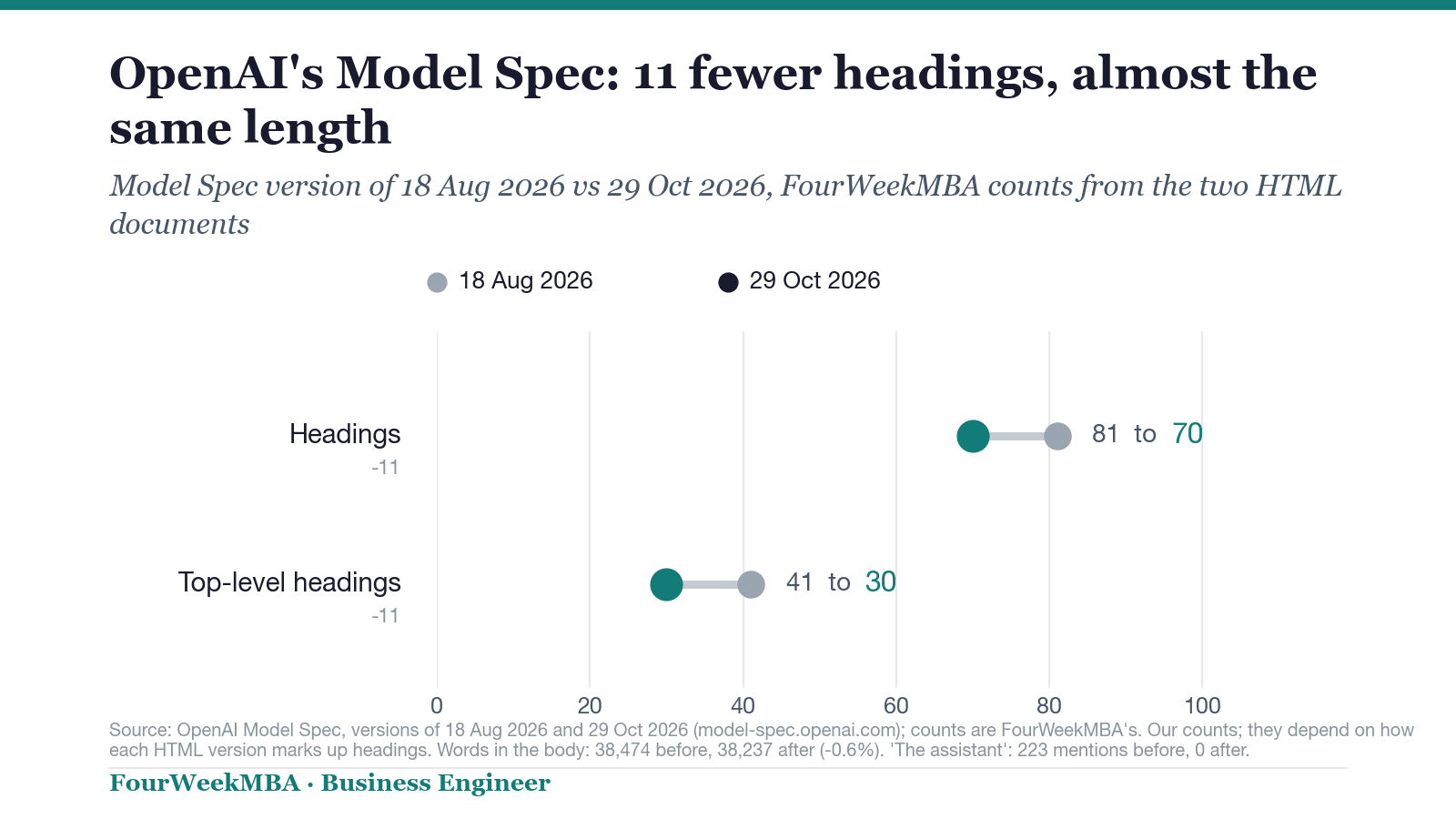
The most visible edit is one of vocabulary. Throughout the older text, the model was "the assistant", a phrase that appeared 223 times in the August 2026 version. It now appears nowhere, and the model is called GPT, a word that turns up 324 times. FourWeekMBA's own count shows the headings falling from 81 to 70 and the top-level ones from 41 to 30, while the overall length barely moves, at about 38,000 words either way: 38,474 before and 38,237 after, roughly 0.6% fewer. The edit is therefore a reorganisation and a pruning of detail more than a shortening, with the same ground covered under fewer and broader headings.
“GPT should not change its stance solely to agree with the user”
OpenAI Model Spec, sycophancy section, in the Model Spec · fourweekmba.com ↗
Much of what went was detailed style guidance. Headings such as "Be warm", "Love humanity" and the one on using Markdown with LaTeX extensions are gone, and tone is now meant to follow each user's preferences, although the default of approaching questions from an objective point of view stays. Cutting those lines trims the document's more personality-driven passages and leaves its principles in charge. In their place the Spec adds guidance on weighing context carefully, using conversations and memories to grasp what a person intends, and following social norms. A principle on controlling and communicating side effects moves from the top rule level down to a user-level principle.
The structure of authority is unchanged in outline, and the Spec ranks instructions from Root through System, Developer and User down to Guideline, giving higher-authority and more recent instructions priority when they collide. Tool outputs and untrusted content carry no authority by default. OpenAI sets the outer boundaries, developers direct their applications inside them, and users direct their own work inside whatever developers allow. Most rules are defaults that can be overridden, with firm limits kept for cases that protect people and society. On human agency, GPT is to help people pursue goals they have chosen and form their own views, without hidden steering or manipulation. The sycophancy section survives the rewrite, so the model is still not supposed to shift its position just to please, and the Spec says its five values are not the outer limit of the human values GPT should respect. It also keeps a commitment to staying open to legitimate human oversight and correction, a trait the text calls corrigibility. Reuters covered the release under a headline that put human intent at the centre.
OpenAI framed the change as making clearer what it wants from models as they take on more autonomous work. It also states plainly that its production models do not yet fully reflect the Spec, which describes where it is heading rather than what ships today, and the text is dedicated to the public domain under a CC0 licence.
The previous version, dated 18 August 2026, had been a narrower update, which AI-TLDR says concentrated on how the models deal with teenagers. This one touches the whole document, and OpenAI says it is exploring new training methods and welcomes feedback on the text.
The reworking invites comparison with Anthropic, which published a new constitution for Claude on 22 January 2026 built on four properties: broadly safe, broadly ethical, compliant with guidelines, and genuinely helpful.
Sources · 3