
Seoul-based music tech startup Neutune says the hard engineering behind tracing AI-made songs back to their sources is largely finished. In an interview with the Korea Times, conducted on 8 October at its Gangnam office, chief executive Lee Jong-pil argued that what holds the field back now is persuading rights holders to agree to licensing, a process he expects to be slow.
The company was founded in 2020 by researchers from KAIST's Graduate School of Culture Technology and builds attribution tools: systems that work out which existing works fed a generated track and how much each contributed. Its Music DNA product scans new music for material drawn from existing recordings. It does this by cutting a song into blocks, by instrument and by section, so that influence can be measured part by part, for instance a stretch running from the 30-second to the 50-second mark.
“In my view, the technology is already settled. The slow part is getting consent from rights holders, and it can't help but be slow.”
Lee Jong-pil, CEO of Neutune, to The Korea Times · koreatimes.co.kr ↗
Lee says that granularity is what makes payment workable. Telling a rights holder only that three named songs were involved in a new track, he explains, is not enough to settle accurately who is owed what. He also notes that the deals labels have struck with AI companies mostly cover training or remixing, so a separate monitoring layer is still needed to check what comes out, something he likens to Shazam for generated music. Voice and likeness are harder to follow than the music itself, though he expects that to be sorted around next year.
Neutune's other product is MixAudio, an AI remix platform launched in 2023 with attribution built in. According to Korea JoongAng Daily, it produces instrumentals from text or image prompts, drawing on a library of roughly 300,000 sound blocks composed by humans, each at least eight measures long. The people who made those blocks are meant to be paid whenever theirs are used. Lee also pictures a fan remix market built on K-pop artists' catalogues, with revenue shared, and says Neutune wants to grow in Korea first.
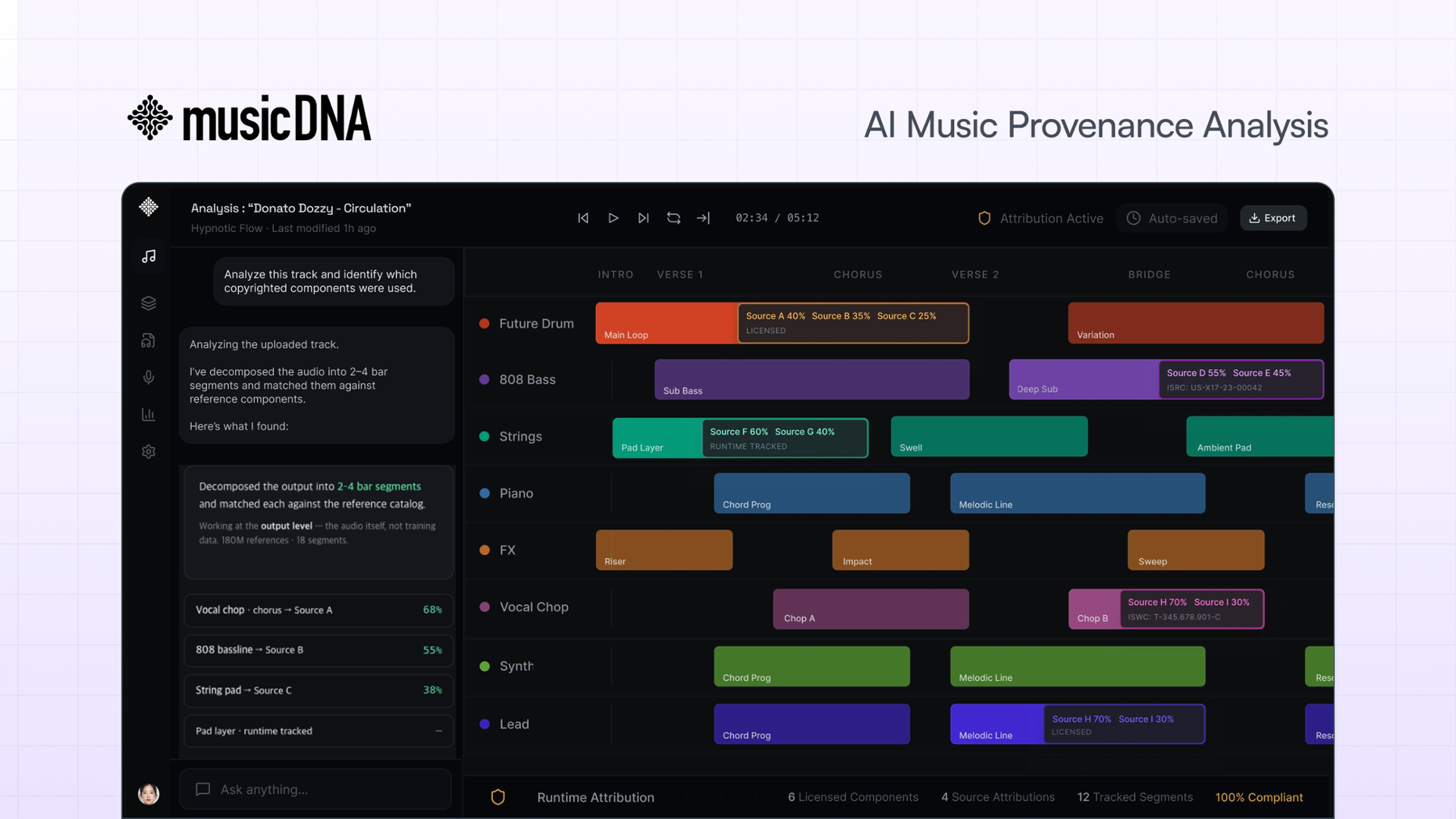
Screen of Music DNA, Neutune's tool that splits a track into segments and matches each against a reference catalog to find its sources
Courtesy of Neutune · Image: The Korea Times
The interview sets this against a market in turmoil. Deezer reports that over half of the new tracks uploaded each day are now AI-generated, peaking at about 90,000 a day in June, up from roughly 10,000 in January 2025. Universal and Warner, which sued Suno and Udio in 2024 alongside Sony, have since settled with Udio, and Warner has settled with Suno as well. Platforms are for now keeping fully AI tracks out of royalty payments, and Korean platforms do not ask distributors whether AI was used. In August the Korea Music Copyright Association issued the country's first rules for registering AI-assisted songs, then withdrew them after 22 days.
Lee frames the divide as legal AI versus illegal AI rather than AI versus humans, and says some composers conceal their use of AI because of the legal exposure of services like Suno. No date is set for a licensing framework; he says an opt-in or blanket arrangement is needed, and that consent will take time.

Lee Jong-pil speaking at the 2025 MWM Conference in Busan, May 2025
Image: Korea JoongAng Daily
Sources · 2