Google has started rolling out a "Memory summary" in Gemini, a page that shows what the assistant has picked up about a user from earlier chats and lets them change it. The rollout began around 9 and 10 November 2026, after Google's Gemini account announced it on X after Android Authority first spotted it, and it is aimed at US users.
In the web app, the page sits under Settings, then Personal Intelligence. Gemini lays out what it knows as a bulleted list sorted into groups: background, location and key relationships, work, interests and preferences. Engadget found it even knew the names of the user's pets. A pen icon opens edit mode, where any line can be rewritten or deleted like text in a document, or a change can be requested in a prompt box before saving. Gemini also keeps a log of what changed and when. Android Central describes an "Essentials" section for the basics.
Access is narrower than the announcement suggests. Google's support page says the user must be 18 or older, in the US, using English, on an active Google AI plan, with both Keep Activity and Memory switched on. The reports disagree on who actually gets it: Tom's Guide reached it on a free account, and Android Central says it seems to work for some free users in web and mobile browsers but not in the Gemini mobile app, though it could not open it there itself.
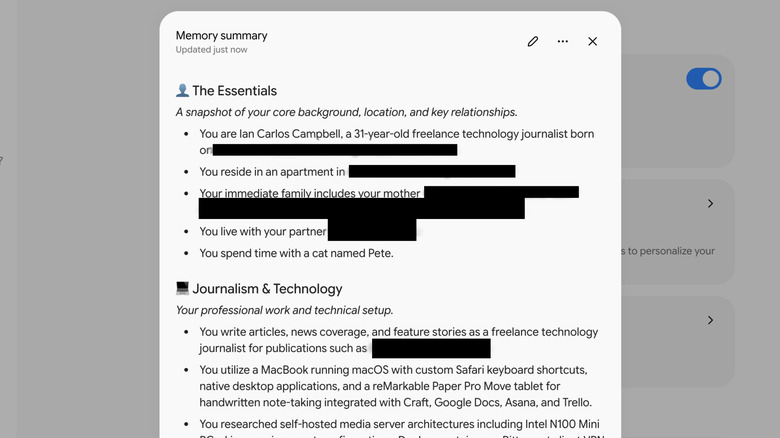
Screenshot of the Memory summary window in the Gemini web app, with its categorised bullet list and edit button
Ian Carlos Campbell for Engadget · Image: Engadget
The controls have limits. Turning Memory off stops new memories from forming but does not erase old ones, which have to be edited in the summary, while chats are deleted under Settings, then Activity. Keep Activity is on by default for adults, and if it is turned off, chats disappear after 72 hours and no longer sync across devices. As an example of memory at work, telling Gemini you are lactose intolerant makes it steer away from milk-based suggestions. Personal Intelligence is the setting that lets Gemini draw on Gmail, YouTube, Search and other Google apps.
About Gemini
Gemini is Google's generative-AI chatbot and virtual assistant, available on Android, iOS, the web and other platforms. It began life as Bard, whose early access opened on 21 March 2023.
Google announced Bard, powered by LaMDA, on 6 February 2023, first to about 10,000 trusted testers, in a move reported as rushed to get ahead of a Microsoft Bing AI event. On 8 February 2024 Bard and Duet AI were unified under the Gemini brand, with an Android app in which Gemini could replace Google Assistant as the default assistant.
Until now Google let people review and delete chat activity but gave no view of what the chatbot had learned, even as Gemini got better at recalling earlier conversations. Engadget argues that editing matters more as the picture of a user grows more intimate. Android Central notes it is unclear whether Google will extend the feature beyond English, so for now it stays limited to US adults writing in that language.
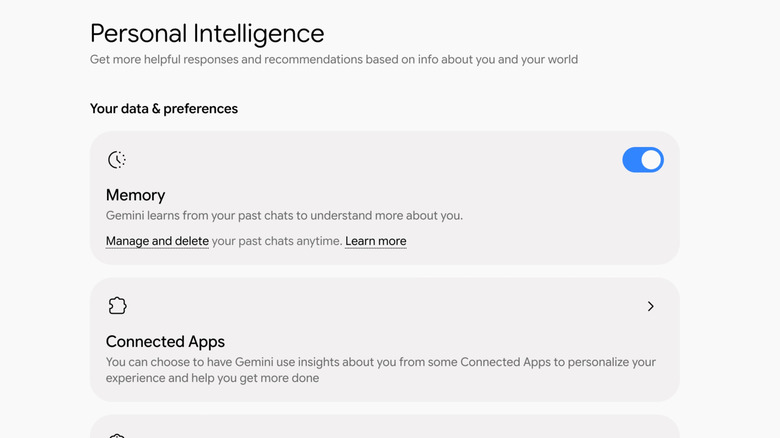
Screenshot of the Personal Intelligence settings where Gemini's Memory toggle sits
Ian Carlos Campbell for Engadget · Image: Engadget
Sources · 3