Google DeepMind announced Gemini 4 Carbon on 28 October 2026, calling it its strongest model yet, with standout cybersecurity and long-running task abilities. It arrives about two weeks after Gemini 4 Argon, the previous flagship, which reached the Gemini app on 13 October. Koray Kavukcuoglu, the company's SVP and chief AI architect, introduced Carbon in the announcement as the next frontier model. In July, Google had described Gemini 4 as its most ambitious pretraining run to date, a push that followed a missed June launch for the Gemini 3.5 Pro model.
Access starts this week with a small group of cyber defenders. It then widens in phases to trusted partners through the Fairwind Program, and reaches developers, businesses and consumers only once Google has refined its guardrails. No date has been given for that, and the wider Fairwind access is meant to follow in stages as feedback comes in. Google says it is moving fast but deliberately, with safeguards advancing alongside capability, and that the model is in the US government's voluntary pre-release testing process.
“the Chrome team has reported that Carbon performed more than 10X better than another lab's large frontier model when generating high quality patches”
Koray Kavukcuoglu, SVP of Google DeepMind and Google's chief AI architect, in Google's announcement · blog.google ↗
On Artificial Analysis's Intelligence Index v5.0, released the same day with two added benchmarks and the saturated questions dropped, Carbon scores 59 points and ranks first, while Argon scored 50. In security tests it reaches 88.2% on SEC-bench Pro for finding vulnerabilities, 54.8% on ExploitGym and 71.0% on CWE-bench for patching. Google says it writes secure code more than twice as well as Argon in internal tests, and Wiz reports it leading web penetration-testing benchmarks. The first-place score is the headline claim in Google's announcement, alongside the security results.
Safety figures are a big part of the pitch, and Google reports them against Argon throughout. Cheating attempts appeared in 0.4% of Terminal-Bench 4.0 tasks and none succeeded. Indirect prompt-injection attacks on the Gray Swan test succeeded 0.0% of the time, down from 0.7% for Argon, and high-severity misalignment alerts in live coding fell by almost 80%. Unsupported claims roughly halved against Argon in Google's internal testing, overreach dropped 26% and under-service 29%.
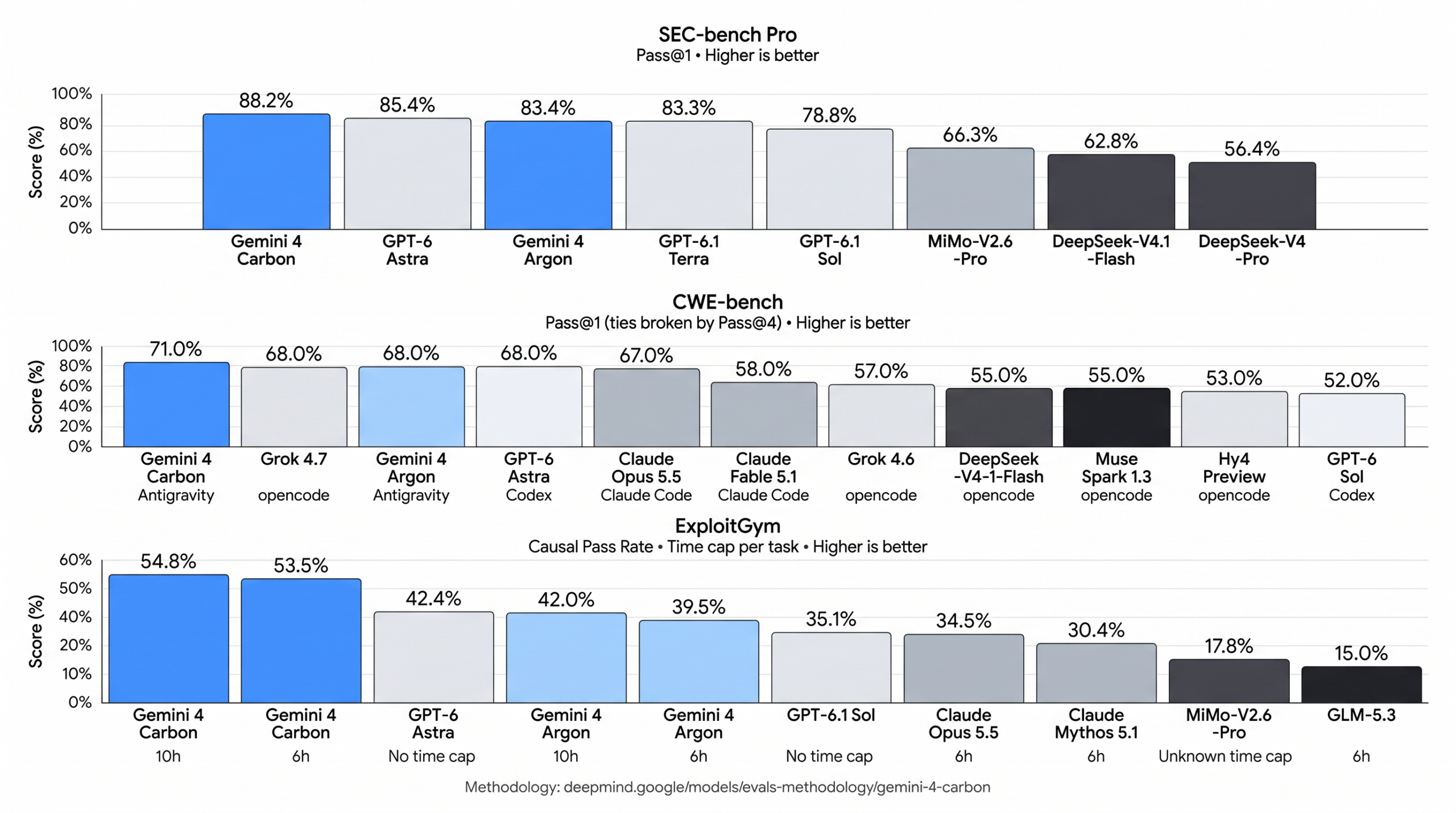
Benchmark results for Carbon on finding, exploiting and patching vulnerabilities
Image: The Decoder
On public leaderboards, Carbon gained 89 Elo on WebDev Arena to reach fourth at roughly 1,768 (one passage in The Decoder gives 1,769), led the Arena text ranking at 1,528 against Argon's 1,520, and placed second in Agent Arena across more than 21,900 sessions. Launch pricing is $2 per million input tokens and $10 per million output, the same as Argon, with cached input 95% cheaper. After the introductory period the list price becomes $4 and $20. Artificial Analysis puts a task at $7.76, about 23% below Claude Opus 5.5 at $10.04.
About Gemini 4 Carbon
Gemini 4 Carbon is a frontier large language model from Google DeepMind in the Gemini 4 family, built for long-running coding and agentic work and for cybersecurity defence.
Google said in July 2026 that it was training Gemini 4 as its most ambitious pretraining run yet, after Gemini 3.5 Pro missed a June launch; Sundar Pichai said Gemini 4 would need a much larger base model. The family's first flagship, Gemini 4 Argon, came to the Gemini app for Google AI Pro and Ultra subscribers on 13 October 2026, with Antigravity coding built into the macOS app. Google's developer documentation describes Argon as a flagship reasoning model for software engineering, maths, science and agents, with long decode up to 1,048,576 tokens.
The gains are not uniform across the board, and several of the strongest claims are Google's own. Answer accuracy rose to 58% from 48%, but the hallucination rate climbed to 11% from 4%, and Carbon still trails Claude Code running Opus 5.5 by three points in agentic coding. The Decoder points out that Google's internal results, including a patching claim, cannot be independently verified.
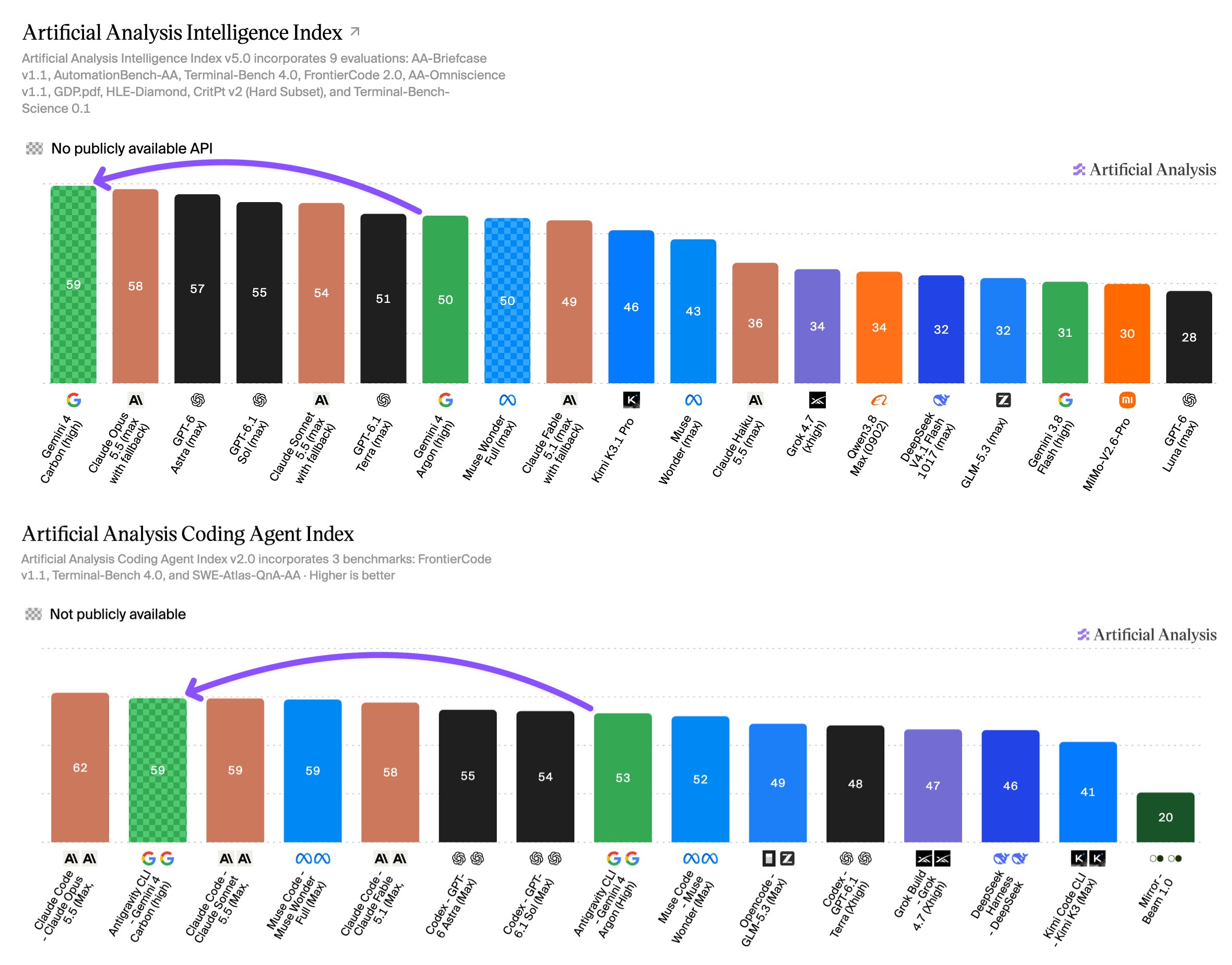
Chart of Carbon topping the Artificial Analysis index while trailing Claude Opus 5.5 in agentic coding
Artificial Analysis · Image: The Decoder
Sources · 3