Apple has announced a large update to Apple Creator Studio, the subscription that bundles its creative apps, and it leans heavily on AI. Apple describes the new features as running on a mix of its own Apple Intelligence models and models from OpenAI. The announcement landed on 27 October 2026 alongside new iMacs and a 14-inch MacBook Pro with the M6 chip, and the update itself reaches the App Store in November, free for people who already subscribe. No exact date has been given.
The headline addition is a set of assistants. Logic Pro for Mac gets one of its own, which can help start a new song, set up a vocal track from a single prompt, or refine a project that is already underway. Keynote, Pages and Numbers share a different assistant that is aware of the document open in front of it. In Keynote it designs, animates and polishes slides, in Pages it drafts and restructures text, and in Numbers it does calculations, organises data, suggests chart types with a one-tap preview and can build tables from general knowledge.
The Logic Pro assistant is the most music-minded of the group. Rather than waiting for a producer to build everything by hand, it can take a single prompt, such as a request for a vocal track, and lay out the session so the producer can start from something playable. It can then step back in later to adjust a project already in progress. Apple's marketing chief for apps expects the assistants to change how people learn to use the apps as well as how they work in them.
For people who would rather use another agent, Keynote, Pages and Numbers on Mac also gain support for the Model Context Protocol. That lets outside AI tools read a document's content, edit it and carry out automated actions inside it.
“the assistant capabilities in Logic Pro, Keynote, Pages, and Numbers are going to change the game for how people interact with and learn to use these apps.”
Brent Chiu-Watson, Apple senior director of Worldwide Product Marketing for Apps and iCloud, in the announcement · apple.com ↗
Video and image work gets a lot of the rest. Final Cut Pro now includes built-in MotionVFX content, a library from a third-party effects maker, thousands of effects, templates, titles and transitions, together with rotoscoping, tracking and colour-grading tools. It can also generate images from text inside a project and send timeline images to Pixelmator Pro, with edits saved back automatically. Motion gets the same MotionVFX plug-ins and text-to-image generation, plus a Displacement filter, so motion designers are covered as well as editors. Apple's curated Content Hub now carries video, and it opens up inside Final Cut Pro.
Final Cut Pro also adds more keyframe easing options, lets editors detach clips from the primary storyline, and supports 23 more transcription languages. In Pixelmator Pro, Generate Fill lets a user circle an area, describe what should be there and get a result that matches the surrounding light, perspective and texture.
It is worth remembering how the subscription got here. Apple introduced Creator Studio on 13 January 2026, and it went on sale on 28 January. That first version already named OpenAI: image creation and editing in Keynote, Pages and Numbers used OpenAI's generative models next to Apple's own Image Playground, and Logic Pro came with its AI Session Player and Synth Player. A June update then added Final Cut Pro's Generate Captions, which runs on the device, and Edit Detection. This October release is the third big step, and the first to put a conversational assistant into every one of the document apps.
Logic Pro's changes are aimed at the producer. Its Browser is redesigned to hold loops, instruments and patches, with a Splice library included, and on-device music understanding now analyses and tags sounds. Stem Splitter, the tool for separating a mixed recording into parts, can pull out, replace or rebalance drum parts without needing the original multitrack files. A Producer Pack from Sergio George adds his piano sound and Latin jazz and salsa loops, and a Voice Memo Studio Sound option cleans up recordings from an iPhone, all in a Liquid Glass redesign of the app. Keynote, Pages and Numbers also pick up the stock video in Content Hub and new premium themes and templates.
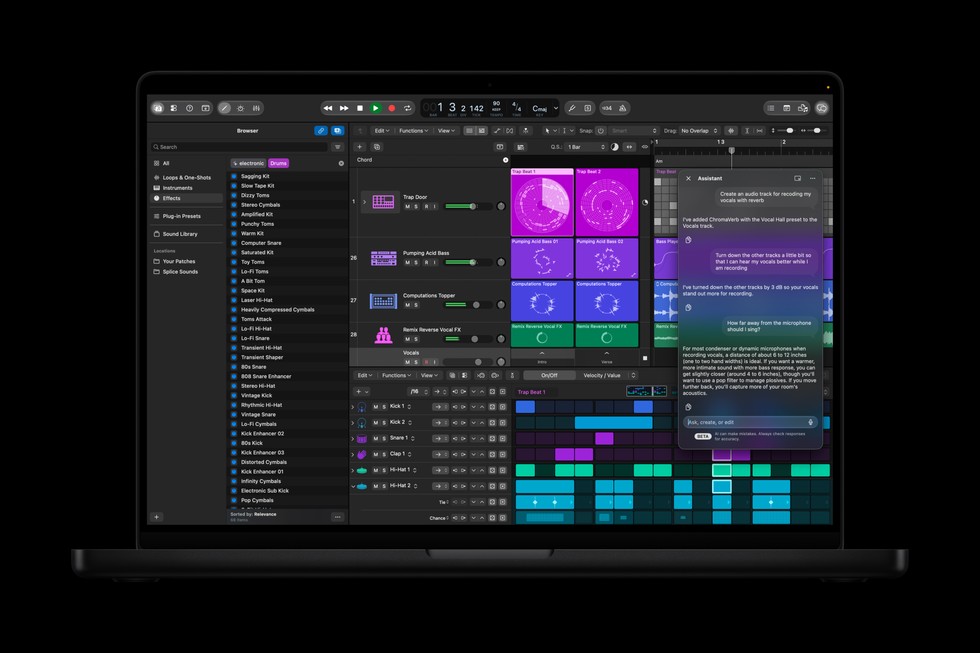
The new intelligent assistant panel in Logic Pro on a MacBook Pro
Apple · Image: Apple Newsroom
The Pixelmator Pro and Final Cut Pro changes link together. A frame can be generated or opened from the timeline, reworked in Pixelmator Pro with Generate Fill, and returned to the project without a manual export, which is the kind of round trip the update is built to make routine. Motion gets the same Pixelmator round-trips, so motion graphics designers get the loop as well.
Smaller changes round out the release. Content Hub's new video library gives editors stock footage without leaving the app, and the new premium themes and templates in Keynote, Pages and Numbers add to what a subscriber gets. In Logic Pro, the Splice library inside the redesigned Browser puts loops and sounds next to the instruments and patches already there, so finding a sound and trying it happen in one place.
There are limits to what ships first. The assistants are in beta, work in US English only, and need a device that supports Apple Intelligence running the version 27 operating systems. Pricing is unchanged: the subscription stays at $12.99 a month or $129 a year in the US, with a one-month free trial. Keynote, Pages, Numbers and Freeform remain free apps, but the new intelligence features are only for paying subscribers, and some Freeform features follow in December. In other words, the free apps stay free, but the AI layer is the reason to pay.
About Apple Creator Studio
Apple Creator Studio is a subscription from Apple that bundles its creative apps, including Final Cut Pro, Logic Pro and Pixelmator Pro, with AI features. New subscribers pay $12.99 a month or $129 a year.
Apple introduced it on 13 January 2026 and it went on sale on 28 January. OpenAI models were part of it from the start: image creation and editing in Keynote, Pages and Numbers used generative models from OpenAI alongside Apple's Image Playground, and Logic Pro arrived with an AI Session Player and Synth Player. A June 2026 update added Final Cut Pro's on-device Generate Captions and Edit Detection.
An analysis from Data Studios points to what Apple has left unsaid. The company has not explained which tasks go to its own models and which to OpenAI's, how work is divided between device and cloud, or how project data is handled when OpenAI models are involved. It also notes there is no mention of Private Cloud Compute or of a ChatGPT sign-in. 9to5Mac, by contrast, treats the MotionVFX deal as the main news and finds OpenAI's presence alongside Apple Intelligence notable in its own right.
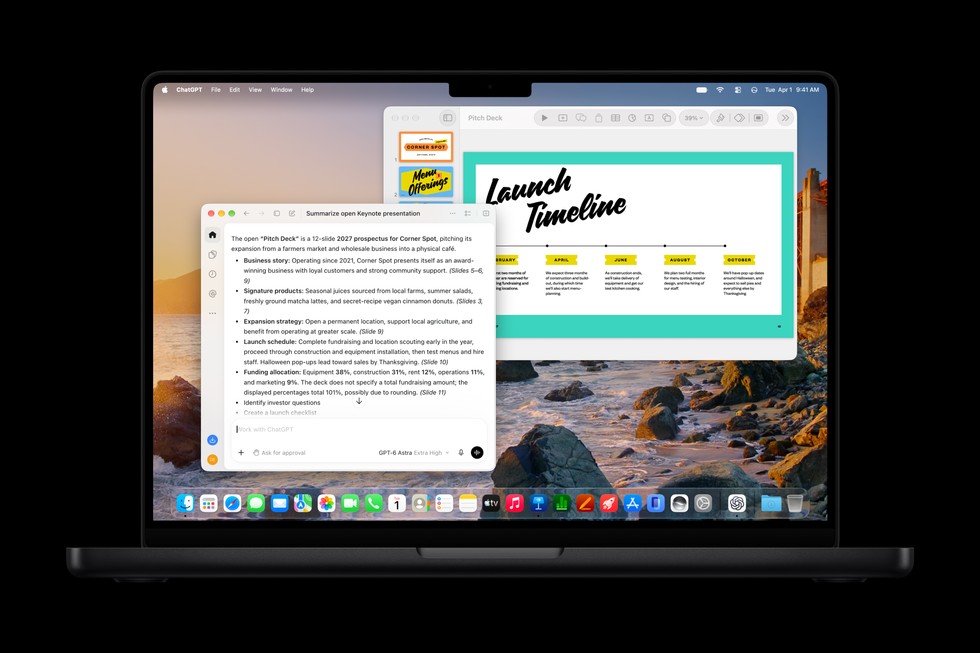
The document-aware assistant in Keynote summarising a pitch deck
Apple · Image: Apple Newsroom
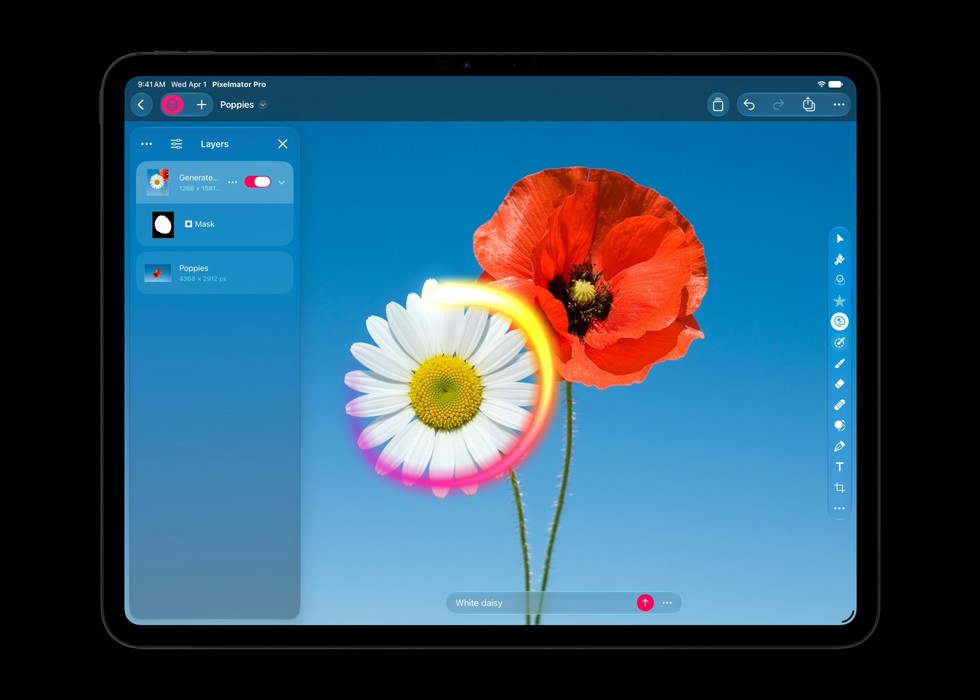
Generate Fill in Pixelmator Pro, which reworks a circled area from a text description
Apple · Image: Apple Newsroom
Sources · 3