
Clip
Phantom Bazaar
Minimax · Getty · 91
17 Oct 2026 · 2,865 works · 700 news indexed
 Mira Okonjo· Studio Halide · 2026 · 14 min · 2.39:1 · English, Yoruba subs
Summary
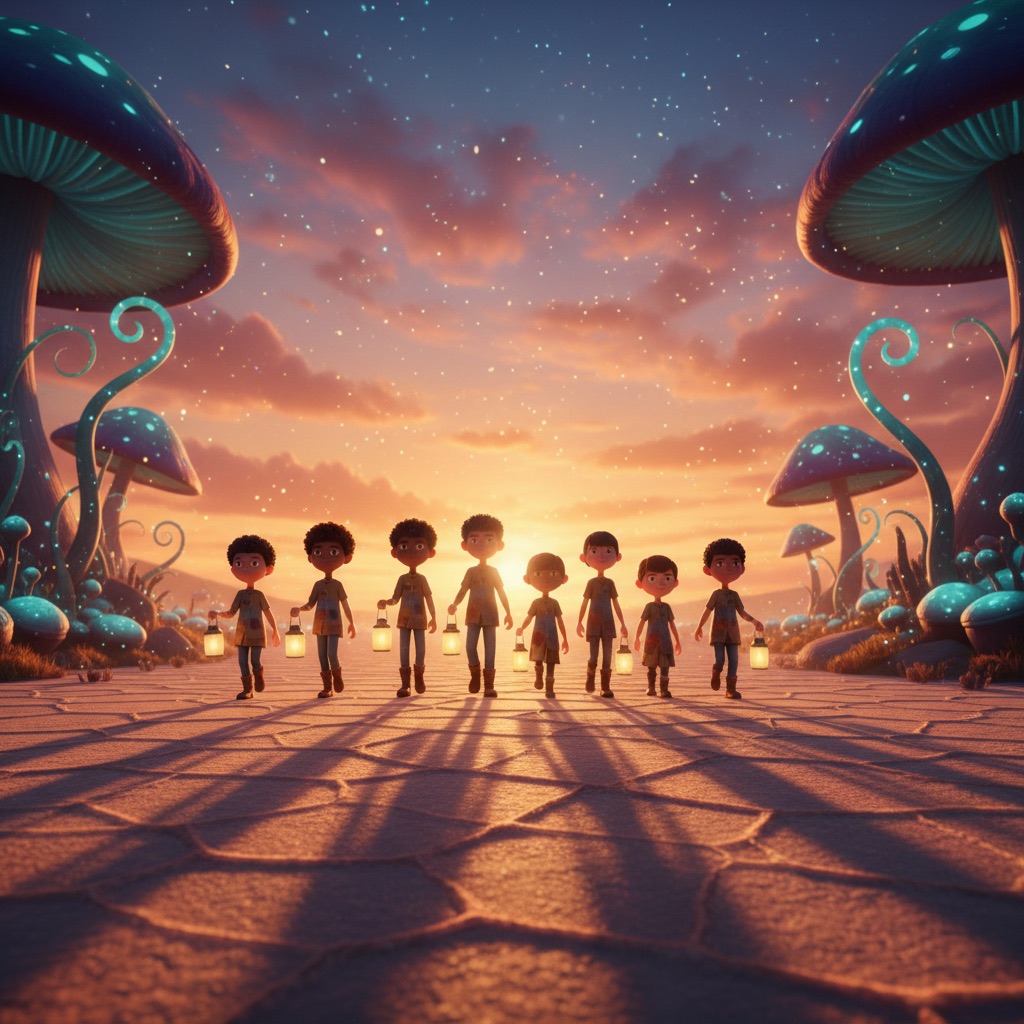
Years later, the lanterns still flickered at the edge of the salt flats — small, persistent flames that no wind could extinguish. The children who had carried them were grown now, scattered across provinces and professions, yet each one still paused at dusk when the light turned amber.
The Lantern Children follows Adaeze Malu, a government surveyor dispatched to chart the shrinking boundaries of an inland sea in a near-future West Africa. Armed with satellite coordinates and a bureaucratic mandate, she arrives expecting routine fieldwork — salt deposits, soil samples, elevation readings. But as the water retreats and the crust hardens underfoot, the landscape begins surfacing memories that are not her own: handwritten place names she has never learned, pathways she recognises without having walked them, and the faint sound of children singing at frequencies her instruments cannot record.
As Adaeze pushes deeper into the salt flats, she discovers a scattered community of young people — the lantern children — who have been living at the margins of the vanishing sea for years. Each carries a small, wind-proof lantern whose flame, they insist, is fed not by oil but by remembering. Through them, Adaeze learns that the sea is not simply evaporating; it is being forgotten, and the land is losing its hold on the events that once took place along its shores. The children's lanterns are acts of resistance — each flame preserving a fragment of communal memory that the drying earth would otherwise swallow.
The film builds to a quiet, devastating conclusion in which Adaeze must choose between completing her survey — which would officially reclassify the sea as non-existent — and abandoning her commission to join the lantern children in their unmapped vigil. Director Chidera Okonjo frames the dilemma not as a contest between science and myth, but as a question about what a society loses when it stops maintaining the places where its stories are stored.
They never spoke of what they had seen beneath the crust, but their maps — personal, unpublished, drawn on the backs of envelopes — all marked the same coordinates, the same unnamed lake that had once held a sea's worth of remembering.


Related content
Clip
Minimax · Getty · 91

Loop
Runway Gen-3 · Pexels · 124

Clip
Sora · Unsplash · 203

Reel
Pika 2.0 · Shutterstock · 58

Short
Luma Dream · Adobe Stock · 312
5.0
A landmark in AI filmmaking. The emotional depth achieved through prompt-driven direction is something I didn't think was possible yet.
4.0
Visually stunning from start to finish. The synthetic actors carry real weight — you forget they aren't human within the first five minutes. My only wish is that the pacing in the second act had matched the intensity of the opening.
5.0
This redefines what a small team can accomplish. Every frame feels intentional.
3.0
The concept is ambitious and the visuals are often breathtaking, but the narrative structure felt uneven. Some scenes land with incredible emotional force while others drift without clear purpose. The soundtrack, however, is absolutely phenomenal — it carries the quieter moments beautifully.
4.0
Watched it twice. The color grading alone is worth studying — every palette shift maps to a narrative beat. The AI-generated environments are indistinguishable from physical sets. A few dialogue moments feel slightly mechanical, but overall this is a genuinely moving piece of work.
5.0
Pure cinema. Proof that the tool doesn't limit the artist — it amplifies them. I was moved to tears by the third act. The score, the editing, the composition — everything clicks into place. This is the future, and it's beautiful.
4 of 148 published
 012
012Veo 3 · 31 takes
012Veo 3 · 31 takes
012Veo 3 · 31 takes
012Veo 3 · 31 takes








On Social Media
On YouTube